

Socotra is one of the rare places where the word “unique” is not just travel marketing. The island has dragon blood trees, white lagoons, limestone plateaus, sand dunes, caves, coral coastlines and plants that look as if they evolved on a different planet. That is why photos of Socotra spread so easily. One picture is usually enough.
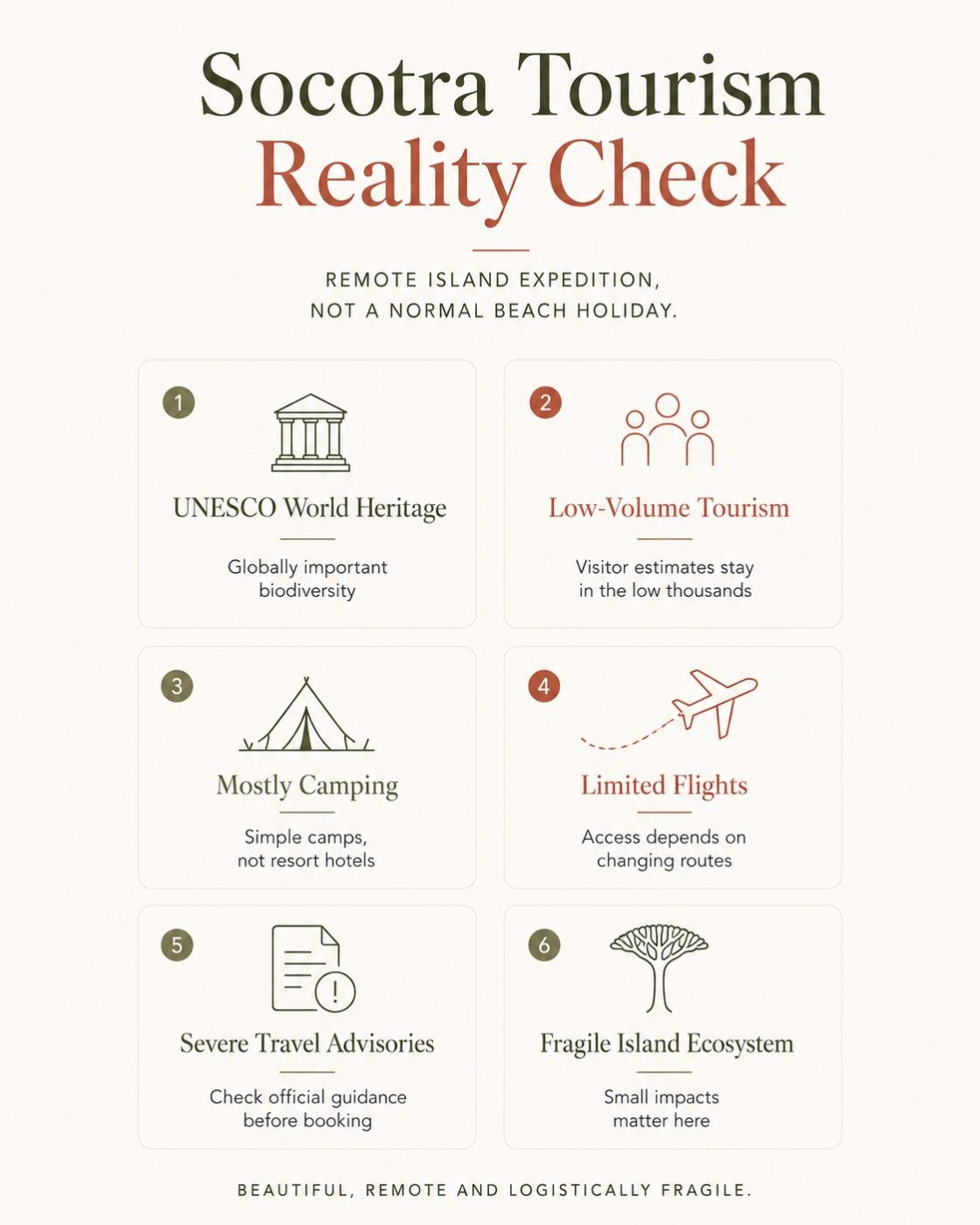
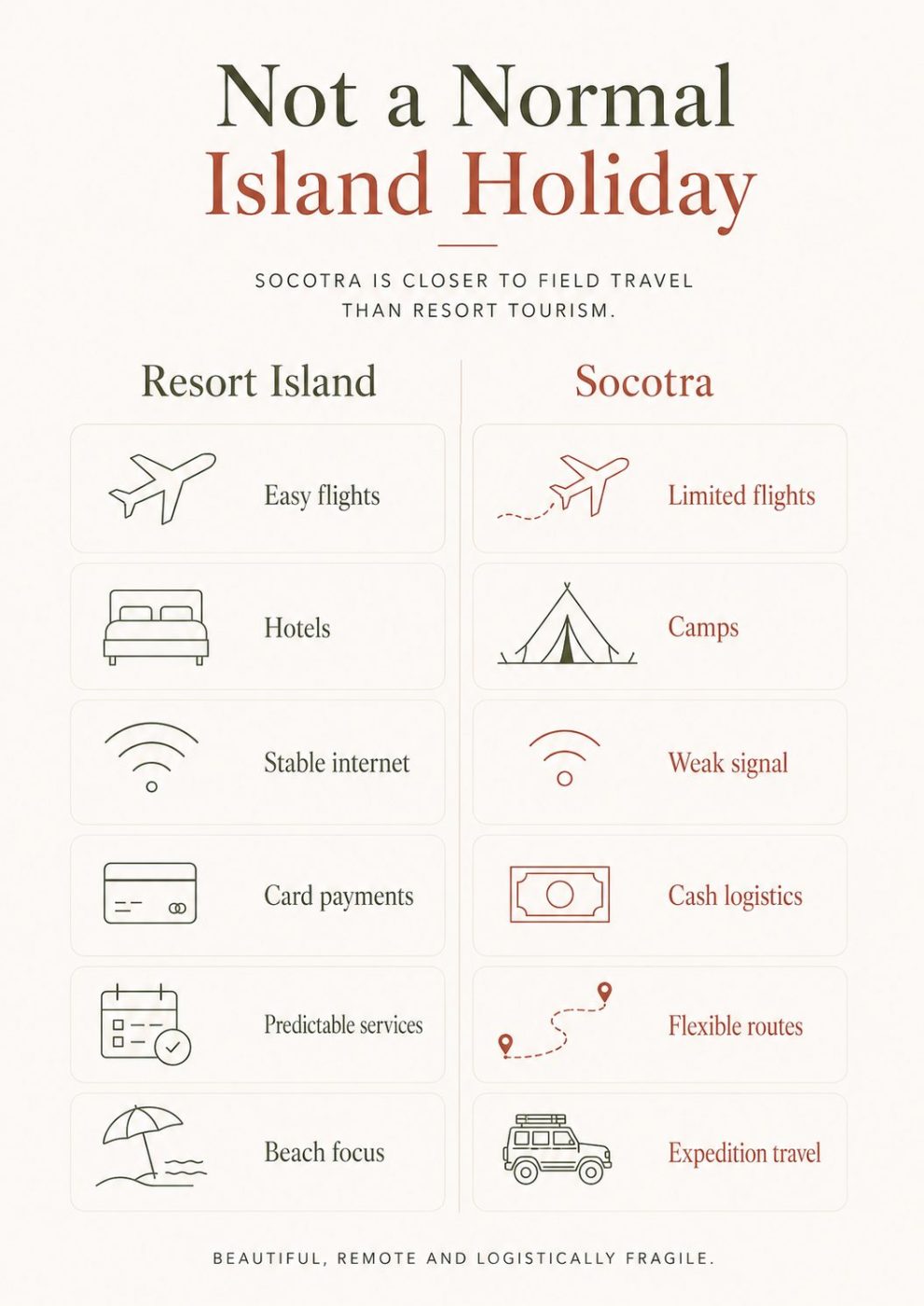
But Socotra tourism is not a normal island holiday. It is not a resort destination with easy flights, predictable infrastructure and polished visitor facilities. Travel here is usually a guided expedition: rough roads, camping, limited connectivity, simple logistics and a high level of dependence on flights, permits, weather and local operators.
There is another layer too. Socotra belongs to Yemen, and many governments continue to advise against travel to the country, including the island. Some travellers report calm and welcoming experiences on Socotra itself, but official warnings, insurance restrictions, medical access, flight disruptions and exit logistics all matter. A trip can feel peaceful on the ground and still carry serious structural risk.
This guide explains what Socotra Island tourism is really like: how many tourists visit, how people get there, what a trip costs, when to go, where tourists usually travel, what conditions are like on the ground, and why responsible tourism matters on one of the world’s most fragile island ecosystems.
Socotra tourism at a glance
A fast way to understand what travel to Socotra is really like before getting into flights, safety, costs and routes.
Yemen
Remote guided expedition
October to April
7 to 8 days
Mostly camping
Severe official travel advisories
Why Socotra Became Famous
Socotra became famous because it does not look like anywhere else. The island’s most recognisable image is the dragon blood tree, with its umbrella-shaped crown standing across dry highlands. Around Firmihin Forest and Diksam Plateau, those trees create the kind of landscape that makes people stop scrolling.
Then there is the coast. Detwah Lagoon has shallow blue water, white sand and a sense of space that feels almost unreal. Arher Dunes rise dramatically near the sea. Hoq Cave gives the island a completely different underground dimension. Socotra is not one view repeated. It is a sequence of strange contrasts.
Social media helped turn the island into a dream destination for adventure travellers. The phrase “alien island” appears often because it is easy and visual. The problem is that it can flatten the island into a fantasy backdrop. Socotra is not strange because it is decorative. It is strange because of long isolation, dry climate, unusual evolution, monsoon influence and fragile ecosystems.
That difference matters. A destination treated as a fantasy object is easy to consume badly. A destination understood as a living island with communities, limits and ecological value requires more care.
Where Is Socotra Island?
Socotra is an island archipelago belonging to Yemen. It sits in the Arabian Sea, near the Gulf of Aden, between the Horn of Africa and the Arabian Peninsula. This geography is one reason the island feels so distinct. It is close enough to major trade routes to have a long human story, but isolated enough to develop an extraordinary natural one.
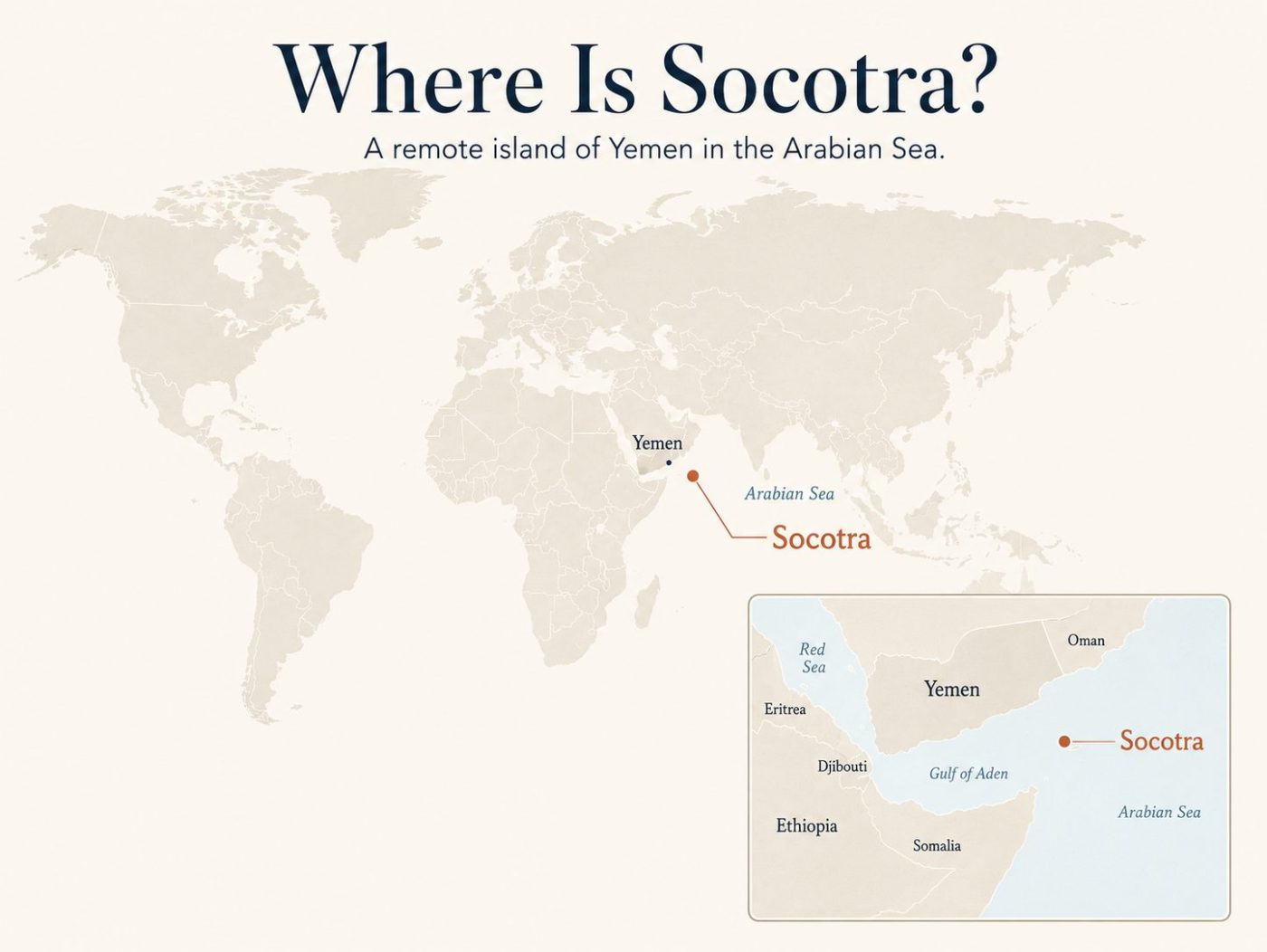
The main island is usually what travellers mean when they say “Socotra,” though the archipelago includes other islands and rocky islets. Most tourism happens on the main island, with routes moving between the airport area, Hadibu, the western coast, central highlands, eastern coast and southern beaches.
Socotra’s remoteness is part of its appeal, but it is also part of the challenge. Supplies, flights, fuel, medical access, communications and evacuation options are not comparable to mainstream island destinations. The same distance that makes Socotra feel untouched also makes travel more fragile.
Why Socotra Is a UNESCO World Heritage Site
Socotra is not important only because it is beautiful. It is globally important because of its biodiversity. The archipelago is a UNESCO World Heritage Site and is famous for its high level of endemism, meaning many species are found nowhere else on Earth.
The best-known example is the dragon blood tree, Dracaena cinnabari, but it is only one part of the story. Socotra also has the swollen-trunk bottle tree of Socotra, the unusual cucumber tree of Socotra, frankincense trees, endemic reptiles, rare birds, land snails and rich marine life.
That is why Socotra tourism should never be treated as just “beaches plus weird trees.” The island’s value lies in the whole system: dry plateaus, wadis, coastal lagoons, cliffs, coral areas, dunes, caves and plant communities adapted to conditions that are difficult to find elsewhere.
This also explains why responsible travel matters so much. A fragile island ecosystem can be damaged by small actions repeated many times: off-road driving, plastic waste, careless camping, plant collecting, reef damage, disturbance of wildlife or treating endemic plants as photo props.
How Many Tourists Visit Socotra?
Tourism statistics for Socotra are harder to pin down than for a normal destination. There is no simple public dashboard that gives clean, current visitor numbers in the way you might expect from a mainstream tourism board. The available figures come from a mix of UNESCO documentation, academic references, operator estimates and travel-industry reporting.
The broad pattern is clear. Socotra had a small but real tourism sector before Yemen’s political crisis. UNESCO documentation has referred to around 4,000 visitors in 2010, followed by a dramatic fall to fewer than 200 visitors in 2015. That collapse shows how dependent Socotra tourism is on political context and access.
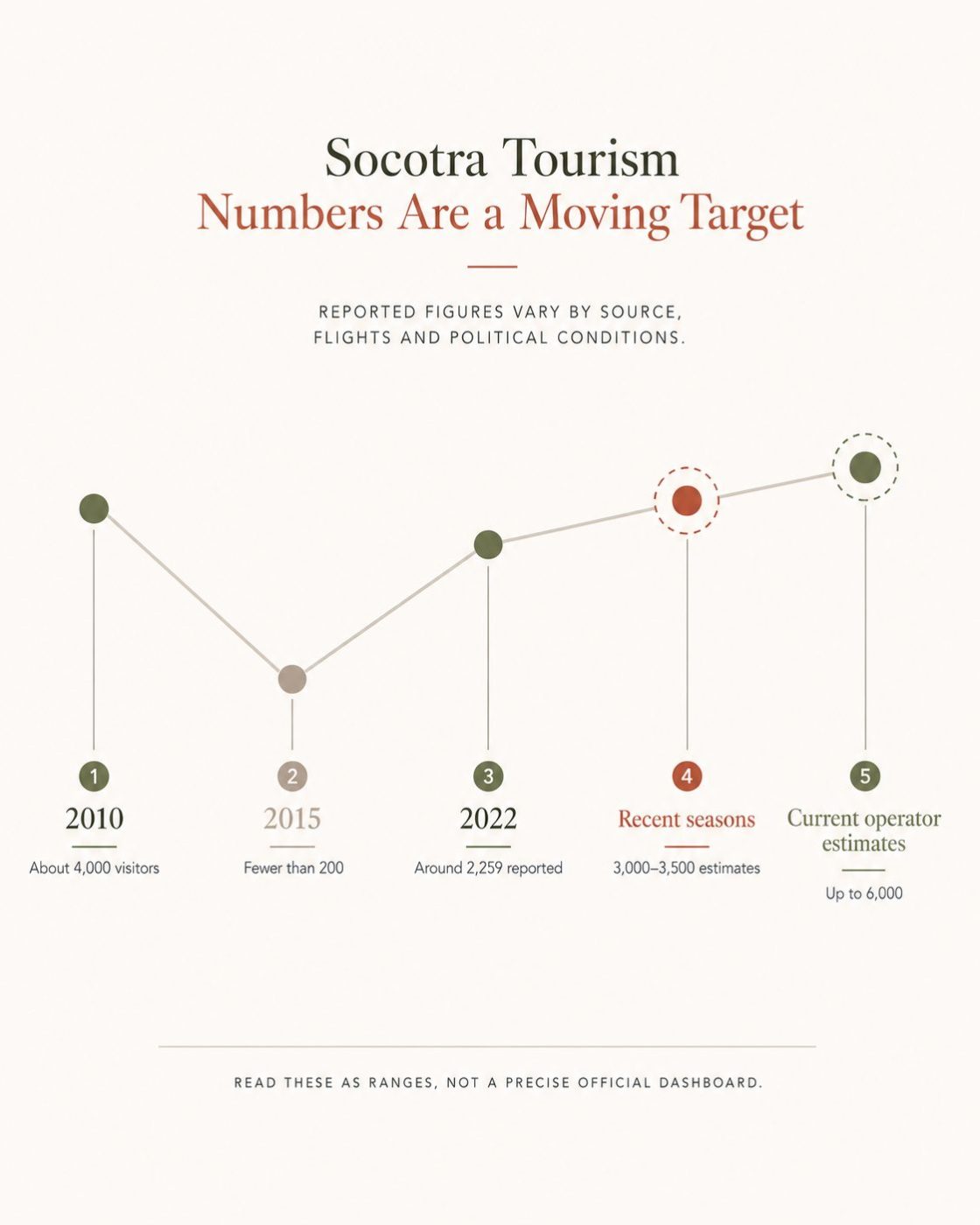
Later figures suggest tourism recovered into the low thousands. Some tourism literature has reported around 2,259 visitors in 2022. More recent industry estimates often mention roughly 3,000 to 3,500 visitors annually, while some operators now claim numbers closer to 6,000 per year. Those higher figures should be treated carefully: they are useful as signs of growth, but they are not the same as verified official statistics.
The honest answer is that Socotra tourism is still small by global standards, but it is growing from a fragile base. A few thousand visitors per year may sound low, yet on an island with limited infrastructure, weak waste systems and sensitive habitats, even low-volume tourism can create pressure.
| Year / period | Reported tourism context | How to read it |
|---|---|---|
| 2010 | About 4,000 visitors in UNESCO documentation | Useful pre-crisis baseline |
| 2015 | Fewer than 200 visitors | Shows the tourism collapse after political instability |
| 2022 | Around 2,259 visitors reported in tourism literature | Use as research-based reported figure |
| Recent seasons | Common industry estimates around 3,000–3,500 annually | Useful modern estimate, not official count |
| Current operator estimates | Some operators claim around 6,000 annually | Use cautiously as operator-reported estimate |
Why Socotra Tourism Statistics Are Hard to Pin Down
Socotra tourism numbers should be read as a moving range, not as the kind of precise arrival statistics you might expect from a mainstream destination. Several things make the numbers messy.
First, access changes. Flights can expand, shrink, move between regional hubs or stop unexpectedly. If flights change, visitor numbers change with them. Second, Socotra has a strong season. Most tourism happens during the more manageable months, while the windy monsoon period is much less practical for normal travel.
Third, different sources may count different things. One source may refer to foreign tourists. Another may refer to total visitors. Another may only count organised tour participants. Operators may also use estimates based on flight seats, bookings or season expectations.
That does not mean the numbers are useless. They still show the main trend: tourism collapsed during Yemen’s crisis, then recovered into a small but growing specialist travel market. The important thing is not to pretend the exact figure is more precise than the available evidence allows.
Is Socotra Open for Tourism?
Socotra does receive foreign tourists through specialist operators. Tours run in the main travel season, itineraries are sold publicly, and many travellers have visited in recent years. In that practical sense, yes, tourism exists.
But “open” does not mean “easy.” Socotra is not a destination where most travellers can simply book a normal public flight, reserve a hotel online, rent a car and improvise. Access depends on flight schedules, visa processing, local sponsorship, tour logistics, security context and the current route into the island.
It is also important to separate tourism access from official safety advice. A place can be receiving tourists while governments still advise against travel. Socotra sits exactly in that uncomfortable space. Tours may operate, but travellers still need to check current government advisories, insurance validity and evacuation realities before booking.
Can You Travel to Socotra Independently?
In practical terms, most foreign visitors travel to Socotra through specialist operators. That is not just because it is convenient. It is because the island’s logistics are difficult to separate into normal independent-travel pieces.
Visas and permissions are usually arranged through a sponsor or tour company. Flight seats may be coordinated through operators rather than ordinary booking platforms. Once on the island, travellers need 4×4 vehicles, drivers, local guides, camping equipment, food supplies, route planning and knowledge of conditions on the ground.
Socotra does not currently work like a normal destination where you book a public flight, rent a car and improvise your route day by day. Even experienced independent travellers usually need a structured arrangement because the basic travel system is built around organised expeditions.
That does not mean every tour is the same. There are group tours, private tours, budget-oriented operators and more comfortable expedition-style arrangements. But the framework is usually similar: airport pickup, guided overland route, camping, local support team and a fixed or semi-flexible itinerary.
Is Socotra Safe to Visit?
This is the most sensitive question in Socotra tourism, and it should not be answered with a lazy yes or no.
Socotra is part of Yemen. Many governments advise against travel to Yemen, including Socotra, because of conflict, terrorism, kidnapping risk, political instability, limited consular support and unpredictable security conditions. Those warnings are serious and should not be ignored because a travel company says the island itself feels calm.
At the same time, many travellers who have visited Socotra describe the island experience as peaceful, welcoming and calm on the ground. Local communities are often described warmly, and the daily rhythm of a Socotra trip is usually about driving, camping, swimming, walking and visiting natural landscapes.
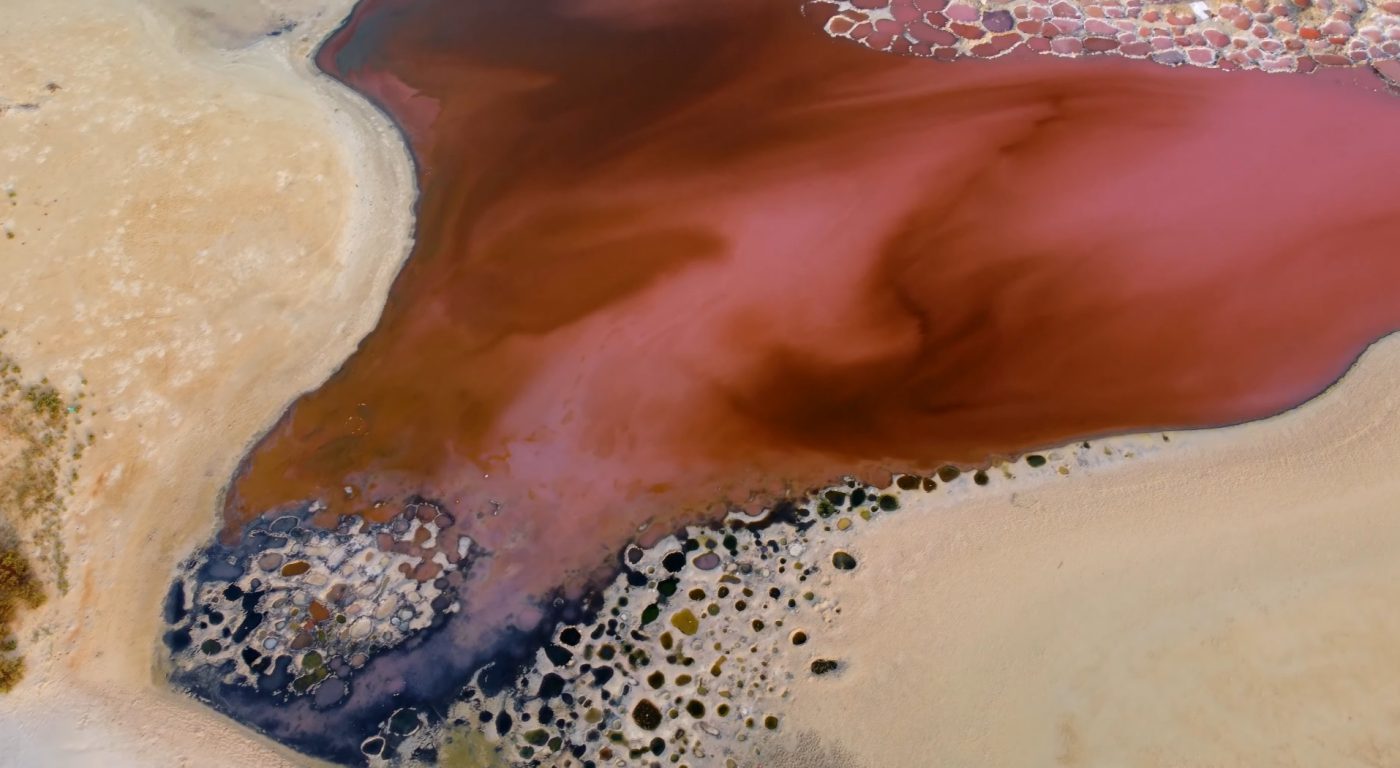
Both things can be true. The island may feel calm during a trip, while the wider risk structure remains serious. Official advisories are not only about whether a visitor feels comfortable at a campsite. They also consider what happens if flights stop, if regional politics shift, if medical evacuation is needed, if consular support is unavailable, or if insurance refuses coverage because the destination is under a do-not-travel warning.
A responsible Socotra tourism guide should therefore say this clearly: travellers must check current official advice from their own government before considering a trip. They should also confirm whether their insurance covers Yemen and Socotra, whether emergency evacuation is included, what their operator’s contingency plan is, and what happens if return flights are delayed or cancelled.
For more detailed planning context, see the guide on whether it is safe to travel to Socotra.
Official Travel Advice vs Traveller Experience
A common contradiction appears when researching Socotra. Travel reports may say “I felt completely safe,” while government pages say “do not travel.” This can be confusing, but the contradiction is not as simple as it looks.
Traveller experience is personal and immediate. It reflects what someone felt during their specific trip, on specific dates, with a specific operator and route. Official travel advice looks at a wider risk environment. It considers not only day-to-day comfort, but also conflict dynamics, legal status, diplomatic support, insurance, transport disruption, emergency response and the ability to leave.
A trip can feel calm on the ground and still carry serious structural risk.
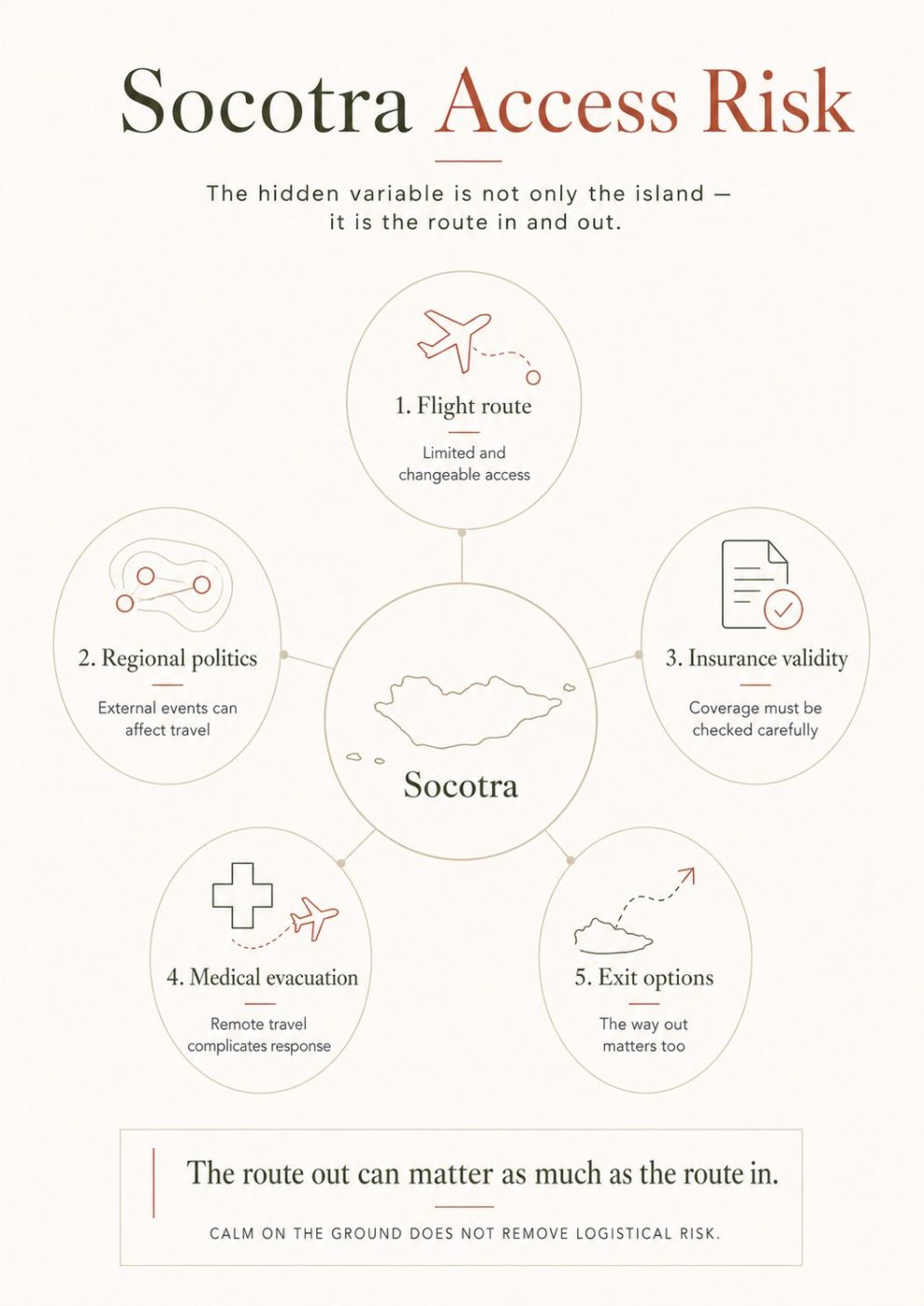
This is especially true for Socotra because the island depends on external links. If the flight route breaks, the problem is not necessarily what happens at your camp that night. The problem is how and when you leave the island. That risk is harder to see in beautiful travel photos.
The Access Disruption: Why Exit Logistics Matter
One of the clearest recent lessons for Socotra tourism came when hundreds of tourists were stranded on the island after air traffic was disrupted during regional tensions. The event was a reminder that the biggest risk may not always look like a dramatic incident at a tourist site. Sometimes the risk is the route out.
For Socotra, access logistics are part of safety. Flights are limited. Routes can shift. Regional politics can affect aviation. Evacuation options are not simple. If you miss a connection or a weekly flight is cancelled, the delay may be more serious than in a normal destination.
This is why travellers should ask operators direct questions before booking:
- What happens if the return flight is delayed?
- Who pays for extra nights?
- Is evacuation coverage included in the insurance?
- What route is currently operating?
- Can the flight be changed or cancelled because of political conditions?
- Is there a realistic backup plan?
Socotra is remote, and remoteness is not just romantic. It affects every practical part of the trip.
How to Get to Socotra
Getting to Socotra changes with time, route access and political conditions. In recent seasons, many tourist trips have used a route through Jeddah, with a limited Yemenia service between Jeddah and Socotra. Some operators describe the route as once weekly, often structured around fixed tour dates.
Older travel information may mention Abu Dhabi as a main access point. That route has changed in recent travel seasons, which is a good example of why Socotra articles become outdated quickly. A guide from even a year or two ago may describe a flight pattern that no longer works.
The practical rule is simple: check the current route with your operator before making any non-refundable plans. Do not assume flights work like a normal tourism market. Do not assume public booking platforms show the full picture. Do not assume the route you saw in an old blog post is still operating.
Flight costs quoted by operators often sit around the high hundreds of dollars for the regional return leg, commonly around $900–$950 in recent examples. Prices, schedules and availability can change, so they should be treated as planning estimates rather than permanent facts.
Flights, Visas and Permits
Flights, visas and permits are usually part of the same planning chain. Most visitors do not arrange them as separate casual tasks. A tour operator or local sponsor typically helps coordinate visa processing, flight seats, island arrival, transport and route logistics.
Before booking, ask what is included. Some prices include visa processing and island logistics but not the regional flight. Others bundle more into one package. Some quote the tour base price separately from the Jeddah–Socotra flight, visa fee, tips, extra nights and international flights to the regional hub.
You should also ask about timing. Visa processing can take time. Flights may be tied to fixed weekly dates. If your international flight into the regional hub is delayed, you may miss the Socotra connection. If the return flight from Socotra is delayed, your onward flights may be affected.
The safest approach is to build flexibility into the trip. That may mean arriving in the regional hub early, avoiding tight onward connections, checking cancellation terms, and making sure your insurance covers both Yemen/Socotra and disruption scenarios.
How Much Does a Socotra Trip Really Cost?
Socotra is not a cheap destination, even though the on-island conditions are simple. The cost comes from restricted access, limited flights, specialist logistics, 4×4 transport, guides, camping equipment, food supply, permits and the difficulty of operating in a remote island environment.
Listed group tours often start somewhere around $1,950–$2,450 for an eight-day trip, depending on operator and inclusions. The regional return flight to Socotra is often quoted separately, commonly around $900–$950 in recent examples. Visa or processing costs may add around $150–€200, depending on operator and arrangement.
That means the realistic total is often higher than the headline tour price. Once the regional flight, visa, tips, insurance, hotel nights before or after the flight, gear and international travel to the hub are included, many travellers should expect something closer to $3,000–$4,000+ per person before long-haul flights, depending on comfort level and inclusions.
| Item | Typical recent examples |
|---|---|
| 8-day group tour base price | Often around $1,950–$2,450 depending on operator and inclusions |
| Regional return flight to Socotra | Often quoted around $900–$950 |
| Visa / processing | Often around $150–€200 |
| Realistic total before long-haul flights | Often around $3,000–$4,000+ per person once extras are included |
Best Time to Visit Socotra
The main Socotra travel season is usually October to April. This is when conditions are generally more manageable for overland travel, camping, beach stops, highland routes and boat-dependent activities. Many classic itineraries run during this period.
November to March is often the most comfortable core season, with better conditions for moving around the island. April can still work, but heat may become more noticeable. May is more transitional. June to September is generally associated with strong monsoon winds and more difficult travel conditions, especially around the coast and sea.
This does not mean every day from October to April is perfect. Socotra is still exposed, remote and weather-influenced. Wind, sea conditions, rain, road access and heat can affect a route. The best season simply gives you a better chance of a workable trip.
For a deeper month-by-month breakdown, see the full guide to the best time to visit Socotra.
When Socotra travel is usually most manageable
How Many Days Do You Need on Socotra?
Most classic Socotra trips run for seven to eight days. That length works because flight schedules often dictate the rhythm, and it gives enough time to see the island’s major landscapes without rushing every stop.
A five-day trip can show a few highlights, but it will feel compressed. Socotra’s roads, distances and conditions do not reward overpacking. You need time for highlands, beaches, lagoons, dunes, caves, marine areas and simple camp life.
A ten-day or longer trip is better for photographers, slower travellers and anyone who wants more flexibility for weather, walking, swimming or repeat visits to key areas. The longer the trip, the more Socotra becomes a place rather than a checklist.
For most first-time visitors, seven or eight days is the practical sweet spot.
What a Typical Socotra Tour Looks Like
A typical Socotra tour starts at the airport, where the guide and driver team meet the group and the route begins almost immediately. There is usually no long hotel check-in ritual or resort-style arrival. You land, load the vehicles, get oriented and move into the island.
Most tours use 4×4 vehicles because many of Socotra’s best places sit beyond smooth paved roads. Some drives are easy. Others are rough, dusty, slow or longer than they look on a map. The island is not huge, but terrain and road conditions shape the pace.
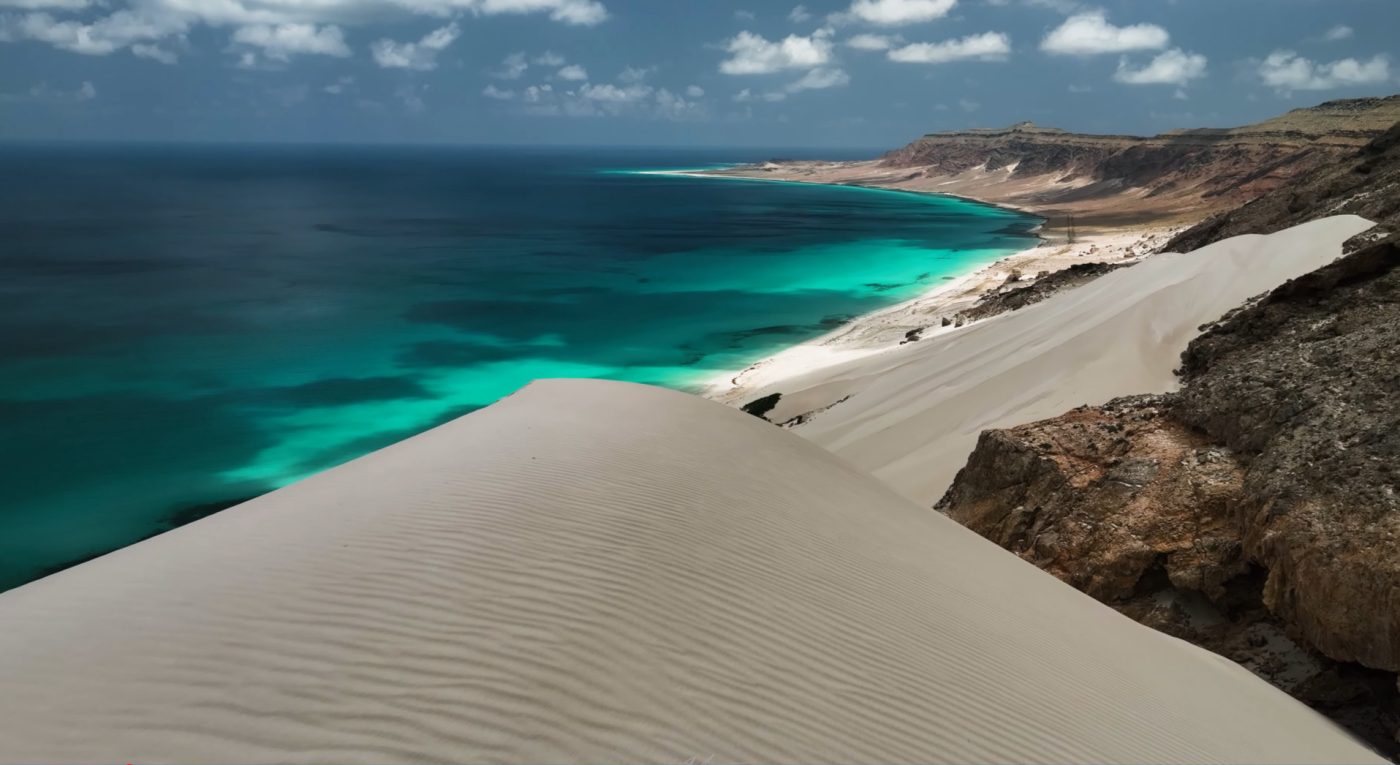
The daily rhythm is usually simple: breakfast at camp, pack up, drive to a landscape or walking area, stop for swimming or viewpoints, eat a basic lunch, continue to the next site, and reach camp before evening. Some days feel active. Others are slower, built around light, heat, road time and the natural rhythm of the place.
Camping is part of the experience. Many travellers sleep in tents near beaches, dunes, lagoons or inland areas, depending on the itinerary. Food is usually prepared by the support team. Facilities are basic. Showers may be limited. Electricity may be irregular. Internet should not be expected as a constant service.
The best mindset is flexible. Socotra rewards travellers who can accept changes without treating them as failures. Wind, sea conditions, roads, permits, heat and flight schedules can all affect the route. A good operator will adjust when needed. A good traveller will understand why.
How a normal day on Socotra often feels
Early start
Breakfast at camp, packing, loading the vehicles and leaving before the strongest heat.
Drive and explore
Road time, viewpoints, walks, beach stops, caves, wadis or movement between major landscapes.
Slower rhythm
More time for swimming, photography, shade, rest or reaching the next camp before evening.
Camp life
Dinner, limited artificial light, sea air or plateau wind, and a pace far from normal package travel.
Where Tourists Usually Go on Socotra
A good Socotra itinerary should not focus on one type of scenery. The island’s strength is variety: lagoons, cliffs, white beaches, high plateaus, endemic forests, dunes, caves, wadis, coral areas and remote camps. The best routes move between these landscapes rather than repeating the same kind of stop.
The exact order depends on flight schedules, weather, operator style and local conditions, but most classic tours include several of the areas below.
Detwah Lagoon and Qalansiyah
Detwah Lagoon is one of Socotra’s most famous coastal landscapes. It is broad, shallow, pale and quiet, with water that changes colour through the day. The place is not only beautiful; it also feels unusually open. There are few destinations where a lagoon can look this empty and this dramatic at the same time.
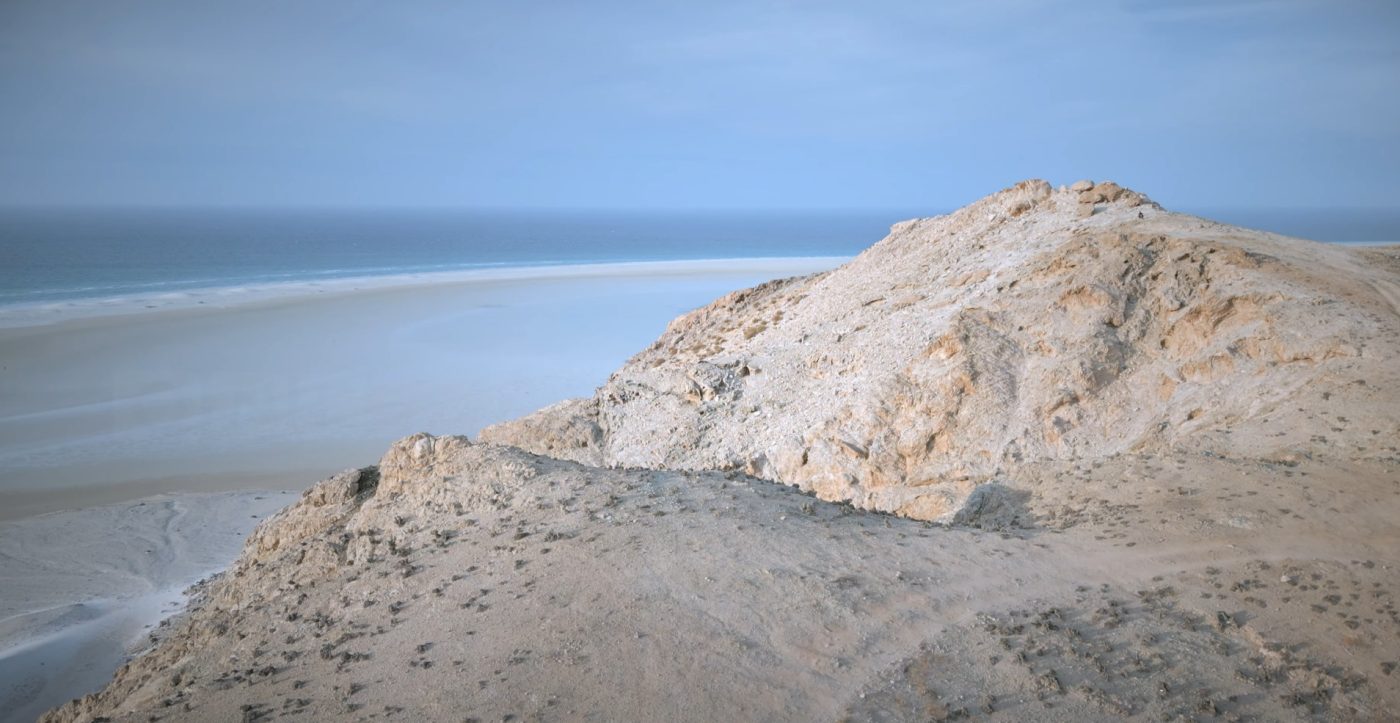
Nearby Qalansiyah is important as the western town and gateway to some of the island’s best coastal scenery. Many travellers pass through Qalansiyah on the way to Detwah or the western coast. It gives the route a human anchor after days of camps, beaches and wild landscapes.
This area is often one of the emotional high points of a Socotra trip. It is also a reminder that coastal beauty here is not resort-style. The setting is wild, simple and exposed.
Shoab Beach and the Western Coast
Shoab Beach is usually reached by boat when conditions allow. It is known for white sand, clear water and the feeling of arriving somewhere separated from roads and ordinary access. The journey itself is part of the experience.
Boat-dependent stops on Socotra are always condition-dependent. Wind, sea state and local judgement matter. A good itinerary should have flexibility rather than pretending every sea activity is guaranteed.
The western coast works best for travellers who understand that Socotra is not about ticking off attractions with mechanical certainty. Sometimes the sea allows the plan. Sometimes it does not.
Diksam Plateau and Firmihin Forest
The central highlands are essential. Diksam Plateau gives travellers the dry inland version of Socotra: limestone, canyon views, rough roads, wind and dragon blood tree landscapes. It feels very different from the coast.
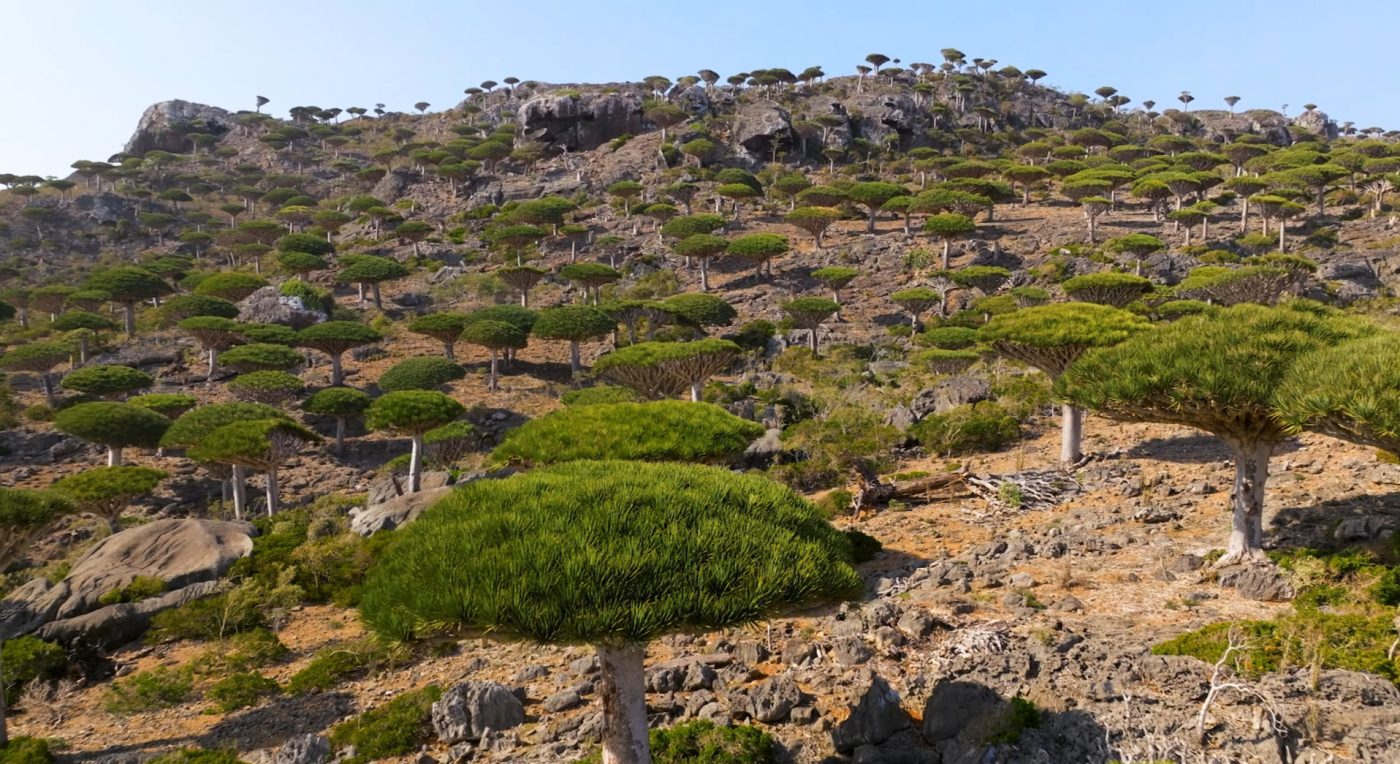
Firmihin Forest is one of the most important places for seeing dragon blood trees. The word “forest” can mislead visitors who imagine dense shade. Firmihin is more open and austere, with umbrella-shaped trees spread across the highlands.
Together, Diksam and Firmihin show why Socotra is not simply a beach destination. The island’s interior is just as important as its coastline, and for many travellers it is the part that feels most otherworldly.
Homhil and the Eastern Highlands
Homhil is a strong nature stop because it combines endemic plants, elevated views and a natural pool. It is often one of the best places to understand how Socotra’s highland vegetation differs from the coastal zones.
This area can include dragon blood trees, bottle trees, frankincense and other distinctive vegetation, depending on the exact route and conditions. The walk to the viewpoint and natural pool is not just a side activity. It is part of the way travellers experience the island’s vertical landscape.
Homhil also fits naturally with eastern or northeastern routes, especially when combined with cave or coastal stops.
Arher Dunes and the Eastern Coast
Arher Dunes are one of Socotra’s clearest visual contrasts: a huge wall of sand rising near the sea, backed by cliffs and exposed coastline. This is the kind of place that makes Socotra feel unreal even to people who have already seen the dragon blood trees.
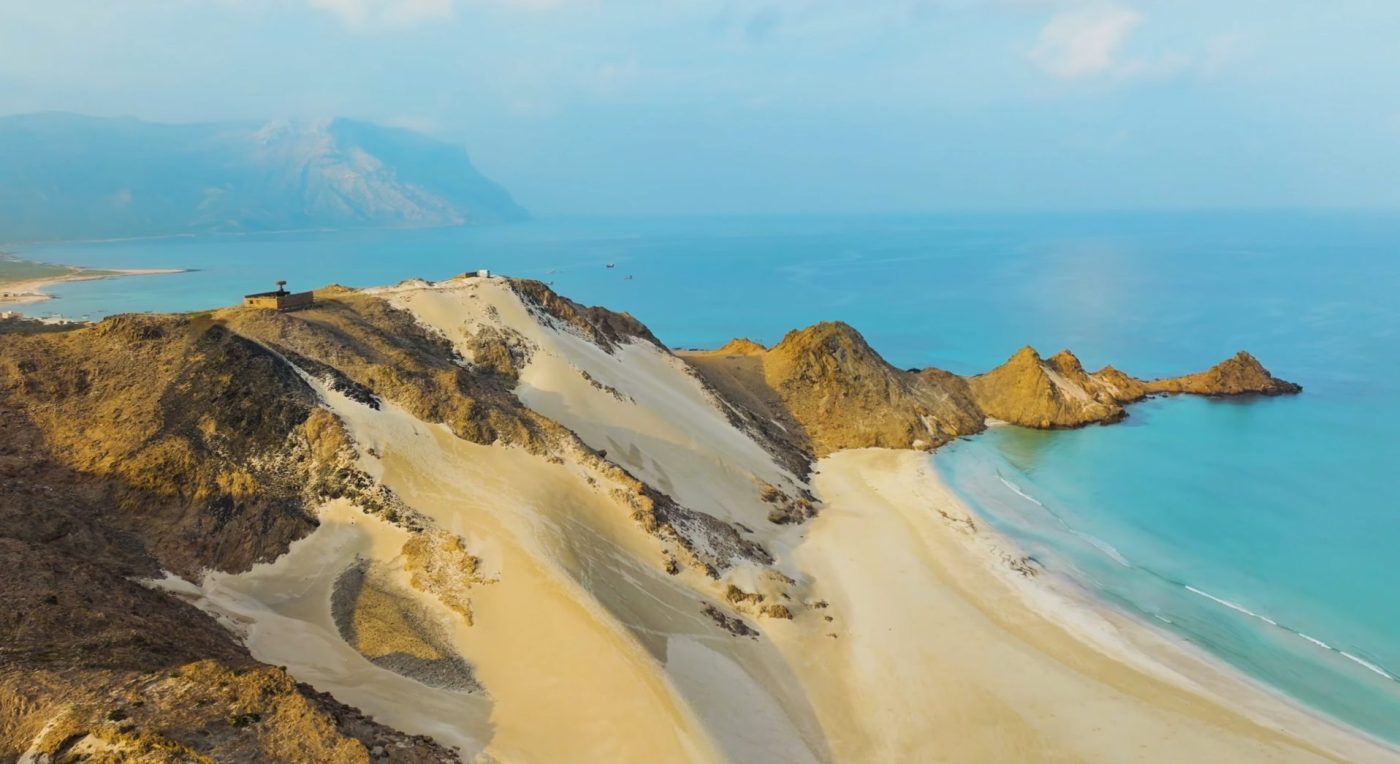
The eastern coast can be windy and exposed, but that is part of its power. It does not feel manicured. It feels elemental: sand, sea, cliffs, light and wind.
Some routes also include Ras Erissel, the eastern tip of the island, where the meeting of sea, wind and open horizon gives a different kind of endpoint feeling.
Dihamri Marine Protected Area
Dihamri is one of the key marine stops on Socotra. It is often used for snorkelling when conditions are suitable and gives travellers a look at the island’s coastal biodiversity rather than only its famous landforms.
Marine areas require especially careful behaviour. Do not stand on coral, chase fish, collect shells or treat the reef as a playground. Socotra’s marine life is part of the same UNESCO-level value that makes the island globally important.
Hoq Cave
Hoq Cave adds a completely different texture to the route. After beaches, dunes and highland trees, the cave brings travellers into limestone, darkness, formations and archaeological atmosphere.
The hike and cave visit require more effort than a beach stop, but the reward is variety. A strong Socotra itinerary should include at least one place that breaks the visual rhythm, and Hoq Cave does exactly that.
Wadi Kalisan, Wadi Ayhft and Dirhur Canyon
Socotra’s wadis and canyons are important because they show how water shapes the island. Wadi Kalisan, Wadi Ayhft and Dirhur Canyon each bring a different inland mood: rock pools, canyon walls, vegetation pockets, rough tracks and walking sections.
These places are useful in a tourism guide because they stop Socotra from being reduced to a few famous postcard views. The island has hidden depth. Some of it appears only when you move away from the obvious coastal highlights.
Places that define a classic Socotra route
Detwah Lagoon
Wide shallow water, pale sand and one of the most memorable coastal landscapes on the island.
Best for: lagoon scenery and western route
Diksam Plateau
Central highland scenery with canyon views, rough tracks and dragon blood tree landscapes.
Best for: highlands and endemic trees
Arher Dunes
A dramatic dune wall rising near the sea, showing Socotra’s raw coastal contrast.
Best for: dunes, coast and camp atmosphere
Homhil
A highland nature area with endemic plants, elevated views and a natural pool.
Best for: walking, plants and viewpoints
Accommodation: Camping, Guesthouses and Basic Facilities
Most Socotra trips involve camping. This is not a minor detail; it defines the experience. You may sleep near beaches, dunes, lagoons, highland areas or simple designated camp spots depending on the route. Some trips include basic guesthouse stays, but travellers should not expect standard hotel infrastructure across the island.
Camping can be beautiful. The sky is dark, the landscapes are quiet, and many camps feel far away from normal tourism. But camping also means simple facilities. Toilets and showers may be basic. Privacy may be limited. Sand, wind and dust are part of the trip. Comfort depends heavily on the operator, equipment and group expectations.
If you need resort comfort, Socotra may not be the right destination. If you are comfortable with simple camps and outdoor conditions, the lack of polish can be part of the appeal.
Roads, Transport and Daily Conditions
Transport on Socotra is usually by 4×4 vehicle. Some roads are straightforward, while others are rough, rocky, sandy or slow. Drive times can feel longer than distances suggest because the terrain demands patience.
Daily conditions vary. Coastal areas can be hot and windy. Highland areas can feel cooler but exposed. Dust is normal. Shade may be limited. Short walks can feel harder in strong sun. Swimming stops may depend on sea conditions, timing and local judgement.
A flexible mindset helps. If you expect everything to run like a city break or resort holiday, Socotra will frustrate you. If you understand it as field travel, the same conditions become part of the experience.
Internet, Electricity, Cash and Medical Access
Practical infrastructure on Socotra is limited and operator-dependent. Some operators now advertise improved connectivity or satellite internet at camps, but that should not be confused with island-wide reliable service. You should still travel as if internet access will be weak, intermittent or unavailable for parts of the route.
Electricity is similar. Charging opportunities may exist through vehicles, generators or camp arrangements, but travellers should bring power banks and avoid depending on constant access. Camera batteries, phones, headlamps and medical devices should be planned carefully.
Cash is usually more practical than card-based travel. Socotra is not a place to rely on ATMs, digital wallets or card terminals. Ask your operator what currency to bring and what expenses are not included.
Medical access is one of the most important limitations. Facilities are limited, and evacuation is not simple. Bring essential medication, a personal first aid kit, any prescription documents you need, and insurance that actually covers your destination and style of travel.
| Internet | Limited and operator-dependent; do not expect normal connectivity throughout the route. |
|---|---|
| Electricity | Charging may be irregular; power banks and spare batteries are useful. |
| Cash | Plan for cash rather than card-based travel once on the island. |
| Medical access | Limited; bring essential medication and check evacuation coverage before booking. |
What to Pack for Socotra
Packing for Socotra is closer to packing for a remote camping trip than for a beach holiday. You need sun protection, practical footwear, simple clothing, personal medication and enough self-sufficiency to handle limited facilities.
- Lightweight long-sleeve shirts for sun protection
- Breathable trousers or hiking pants
- Swimwear and quick-dry towel
- Hiking shoes or sturdy trail shoes
- Sandals or water shoes for camp and beaches
- Hat, sunglasses and strong sunscreen
- Headlamp or small flashlight
- Power banks and spare charging cables
- Dry bag or waterproof pouch
- Personal medication and basic first aid
- Wet wipes and personal hygiene items
- Reusable water bottle where practical
- Cash in the currency your operator recommends
- Copies of passport, insurance and travel documents
The goal is not to overpack. The goal is to avoid needing things that are difficult or impossible to find once the route begins.
Waste, Plastic and the Cost of Remote Tourism
Waste is one of Socotra tourism’s most practical problems. Remote islands often make imported goods look convenient on arrival and difficult afterward. Plastic bottles, wrappers, broken gear and camp waste are harder to manage where formal waste infrastructure is limited.
On Socotra, every plastic bottle is harder to disappear than it was to bring in.
Travellers should reduce single-use plastic before arriving, avoid unnecessary packaged items, follow operator waste rules and never leave rubbish at beaches, campsites, wadis or viewpoints. If an operator treats waste casually, that is a warning sign.
The issue is not only visual litter. Waste affects local communities, wildlife, beaches, lagoons and the reputation of tourism itself. A destination cannot be sold as pristine while visitors leave behind the evidence that it is not being protected.
Can Socotra Handle More Tourism?
Low visitor numbers do not automatically mean low impact. Socotra may receive only a fraction of the tourists that visit mainstream island destinations, but its ecosystems and infrastructure are far more fragile. A few thousand visitors can matter when campsites, waste systems, freshwater points, tracks and sensitive habitats are limited.
Tourism can help Socotra if money reaches local guides, drivers, cooks, families and communities. It can create incentives to protect landscapes and provide income beyond extraction of natural resources. But tourism can also damage the island if it grows faster than management, waste systems, route planning and local benefit.
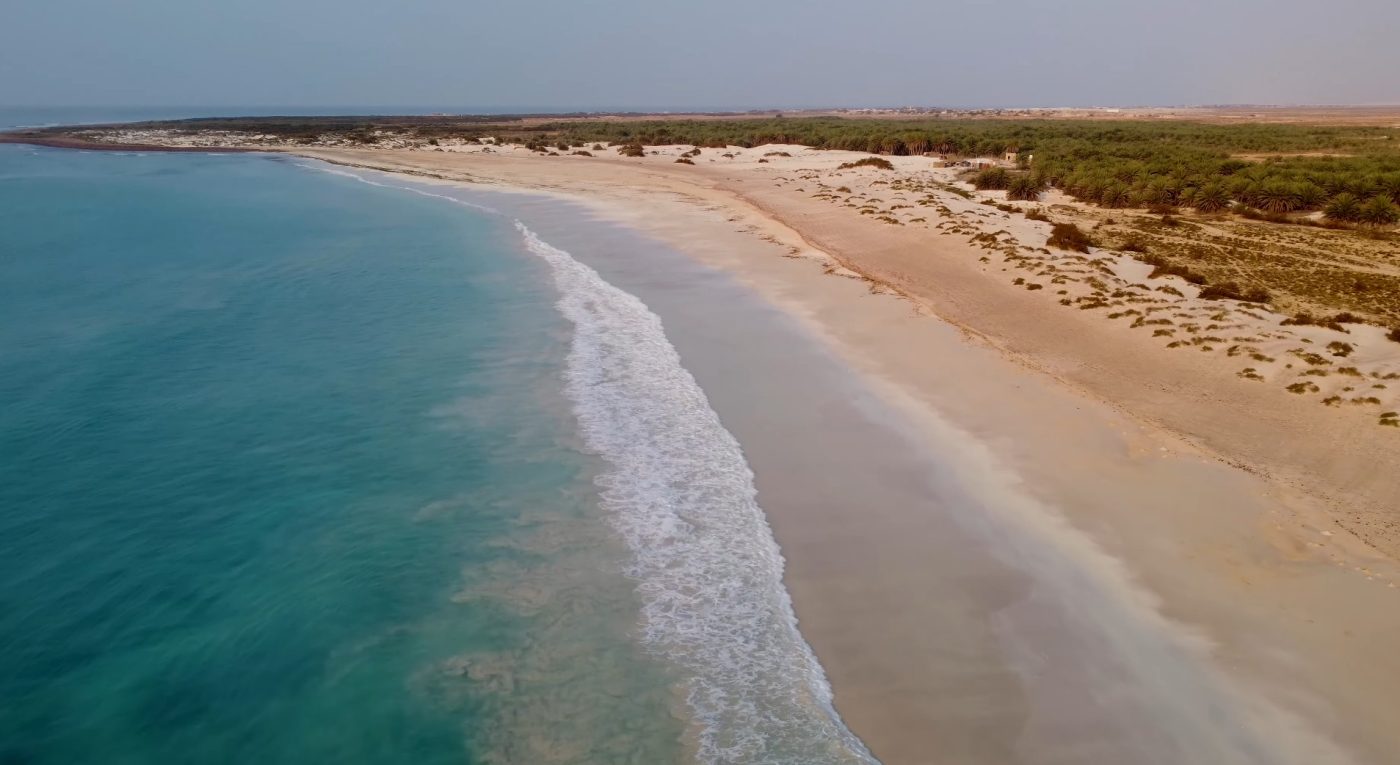
The biggest risks include careless off-road driving, pressure on campsites, plastic waste, wildlife disturbance, damage to dunes and vegetation, reef damage, collecting plants or shells, and the marketing of Socotra as a “last untouched paradise” before it changes.
That phrase — “go before it changes” — is especially dangerous. It turns travel into extraction. It tells people to consume a fragile place before others do. Socotra does not need that kind of tourism. It needs fewer careless visitors and more careful ones.
A better question is not “how soon can I go before it is ruined?” The better question is “can my trip support the people and landscapes that make Socotra worth visiting?”
Responsible Tourism on Socotra
Responsible tourism on Socotra is not complicated, but it does require discipline. The island’s beauty should not be treated as permission to do anything for a photo.
- Use local guides and operators where possible.
- Do not collect plants, seeds, shells, coral, resin or animal material.
- Do not drive off established tracks in fragile dune or vegetation areas.
- Reduce single-use plastic before arriving.
- Pack out waste whenever possible and follow camp waste rules.
- Respect villages, freshwater points, campsites and local customs.
- Do not touch, cut or damage endemic plants.
- Do not stand on coral or disturb marine life while snorkelling.
- Check current safety advice and insurance validity before booking.
The best Socotra travellers are not the ones who collect the most dramatic photos. They are the ones who leave the fewest marks.
Who Should Visit Socotra — and Who Should Not?
Socotra is best for experienced travellers who are comfortable with uncertainty, basic conditions and outdoor travel. It suits people who care about landscapes, plants, wildlife, photography, camping and unusual places more than comfort and convenience.
You are more likely to enjoy Socotra if you can handle rough roads, simple camps, weak internet, changing plans, heat, wind and limited facilities. You also need to be comfortable making a personal risk decision in a destination covered by severe official travel advisories.
Socotra may not be a good fit if you need luxury hotels, reliable medical access, constant internet, predictable flights, easy independent travel, nightlife, shopping, or a low-risk family beach holiday. It may also be a poor choice if your insurance does not cover travel to Yemen or if you cannot absorb delays and logistical changes.
The island is extraordinary, but it is not for everyone. That should be seen as a strength, not a flaw.
Socotra Tourism Myths and Facts
| Myth | Reality |
|---|---|
| Socotra is just a beach destination | It is more like a remote nature expedition with beaches, highlands, caves, dunes and endemic plants. |
| Socotra is easy to visit independently | Most foreign trips are organized through specialist operators because flights, visas and logistics are complex. |
| Low visitor numbers mean no impact | Small numbers can still affect fragile habitats, waste systems and local resources. |
| If tourists feel safe, official warnings do not matter | Official warnings also reflect evacuation, insurance, medical and consular risks. |
| Socotra is a resort island | Most trips involve camping, 4×4 roads, basic facilities and limited infrastructure. |
| The hardest part is choosing places to visit | The harder parts are access, safety decisions, logistics, insurance and flexibility. |
FAQ
Is Socotra open for tourism?
Socotra receives foreign tourists through specialist operators, especially during the main travel season. However, access depends on flights, visas, permits, local sponsorship and the current political and aviation situation. “Open” does not mean easy or risk-free.
Is Socotra safe to visit?
Many travellers describe Socotra itself as calm, but many governments continue to advise against travel to Yemen, including Socotra. The risk includes not only conditions on the island, but also flights, evacuation, medical access, consular support and insurance validity.
How do tourists get to Socotra?
In recent seasons, many tourists have used limited regional flights connected to organised tours, often through Jeddah. Routes can change, and older information may be outdated, so travellers should confirm the current flight path with their operator before booking.
Can you travel to Socotra independently?
Most foreign visitors travel through specialist operators. Visas, flight seats, transport, guides, food, camping equipment and route logistics are usually arranged through a sponsor or tour company. Socotra does not work like a normal independent destination where you simply book a flight and rent a car.
How much does a Socotra trip cost?
Listed group tours often start around $1,950–$2,450, but the regional flight, visa processing, tips, insurance, gear and extra hotel nights can push the realistic total toward $3,000–$4,000+ per person before long-haul flights.
When is the best time to visit Socotra?
The main travel season is usually October to April. November to March is often the most comfortable core period. June to September is generally associated with strong monsoon winds and more difficult travel conditions.
How many days do you need on Socotra?
Most first-time visitors choose seven or eight days because that fits classic routes and flight schedules. Five days can feel rushed, while ten days or more allows a slower and more flexible trip.
Where do tourists sleep on Socotra?
Most tours rely mainly on camping, sometimes mixed with simple guesthouses. Travellers should expect basic facilities, limited showers, simple camp life and conditions closer to field travel than hotel tourism.
Is there internet on Socotra?
Internet access is limited and depends on location and operator setup. Some operators may offer satellite-based connectivity at camps, but travellers should not expect normal island-wide coverage or constant service.
What are the best places to visit on Socotra?
Classic highlights include Detwah Lagoon, Qalansiyah, Shoab Beach, Diksam Plateau, Firmihin Forest, Homhil, Arher Dunes, Dihamri, Hoq Cave, Wadi Kalisan, Wadi Ayhft and Dirhur Canyon.
Why is Socotra a UNESCO World Heritage Site?
Socotra is recognised for its exceptional biodiversity and high number of endemic species. Many plants, reptiles and land snails found on the archipelago occur nowhere else on Earth.
How many tourists visit Socotra each year?
Recent figures vary by source. Historical documentation shows about 4,000 visitors in 2010 and fewer than 200 in 2015. More recent estimates often place annual tourism in the low thousands, with some operator estimates higher. These should be read as ranges rather than precise official counts.
Is Socotra good for luxury travel?
No. Socotra is better understood as remote expedition travel. If you need luxury hotels, stable internet, polished service and predictable logistics, it is probably not the right destination.
What should you not do on Socotra?
Do not collect plants, shells, coral, resin or animal material. Do not damage endemic plants, drive off tracks, leave waste, stand on coral, disturb wildlife or ignore official safety advice and insurance restrictions.
Final Thoughts
Socotra is extraordinary, but it should not be sold as an easy paradise. The island deserves better than that. Its beauty is real, but so are its limits: fragile ecosystems, basic infrastructure, serious official travel warnings, limited flights, weak waste systems and a style of travel that requires patience.
For the right traveller, Socotra can be unforgettable. The landscapes are raw, the biodiversity is rare, and the sense of distance is hard to match. But the best way to approach the island is with clear eyes. This is not a place to consume quickly or casually.
Socotra tourism works best when visitors understand the bargain: the island gives you something rare, and in return you travel carefully, lightly and honestly.