

The bottle tree is one of those Socotra plants that looks almost too sculptural to be real. A swollen trunk rises from dry rock like a water jar. Short branches reach upward. Pink flowers appear against a landscape that often looks too harsh for softness. It is easy to understand why travellers notice it.
But the Socotra bottle tree is more than a strange-looking plant. Its thick body is a survival system. The swollen trunk stores water, buffers the plant through dry periods, and helps it live on rocky slopes where moisture can be brief, uneven and quickly gone. The flowers may be delicate, but the plant itself is built for a hard island climate.
This is also a plant with confusing names. It is often called the Socotra bottle tree, Socotra desert rose, Adenium socotranum, or Adenium obesum subsp. socotranum. The naming can get technical quickly, but the travel version is simpler: when people talk about the bottle tree on Socotra, they usually mean the island’s massive, water-storing desert rose form.
You may see bottle trees in places such as Homhil, Wadi Kalisan, and dry highland or canyon routes around the island. They are part of the same wider botanical story that includes the cucumber tree of Socotra and the famous dragon blood tree.
Socotra bottle tree at a glance
A quick guide to the island’s swollen-trunk desert rose before getting into names, adaptations, flowering and where to see it.
Socotra bottle tree, Socotra desert rose
Adenium socotranum / Adenium obesum subsp. socotranum
Swollen trunk and pink flowers
Desert rose / succulent shrub or small tree
Dry rocky slopes, plateaus and canyon landscapes
Sap can be toxic or irritating
What Is the Socotra Bottle Tree?
The Socotra bottle tree is the island’s famous desert rose: a thick-stemmed, drought-adapted plant known for its swollen base and pink flowers. It is usually discussed under the names Adenium socotranum or Adenium obesum subsp. socotranum, though modern botanical treatment can place these names within the wider Adenium obesum complex.
For a traveller, the first thing to notice is not the scientific debate. It is the body shape. The plant has a swollen trunk or caudex that can look like a bottle, vase, pot, small baobab or polished stone sculpture. In dry Socotra landscapes, that trunk gives the plant a heavy, almost animal presence. It does not look fragile, even when it is flowering.
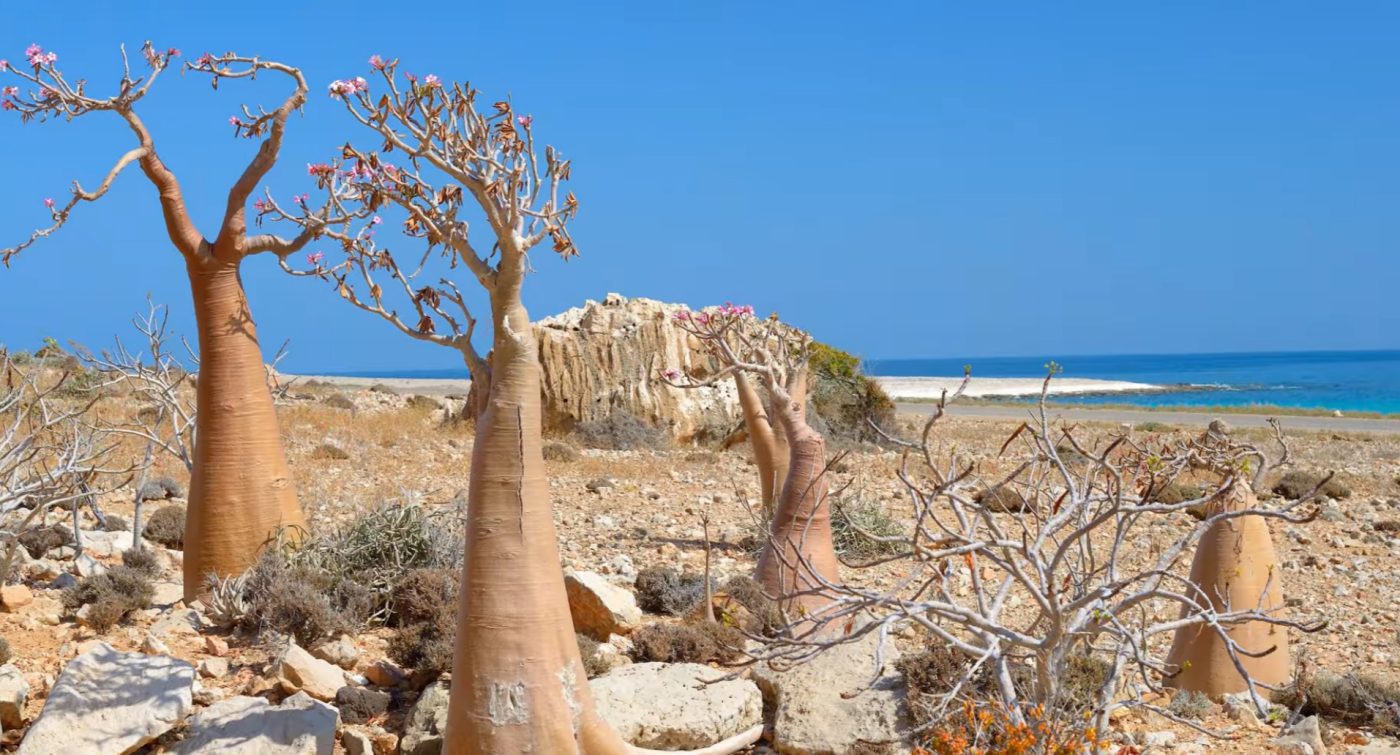
The branches are usually much shorter and thinner than the trunk. Leaves may be present depending on season and local conditions, but the plant can also look nearly bare. When it blooms, the pink flowers often appear near the ends of the branches, which makes the contrast even stronger: rough swollen wood below, bright soft colour above.
This is why the bottle tree should not be described as merely “weird.” It looks unusual because it is adapted to unusual conditions. Socotra is dry, windy, rocky and strongly shaped by microclimates. Plants here often need to store water, avoid waste, withstand exposure and use short favourable periods quickly.
The bottle tree is also not the same plant as Socotra’s dragon blood tree. The dragon blood tree has an umbrella-shaped crown and red resin. The bottle tree has a swollen water-storing trunk and pink flowers. Both are iconic, but they tell different survival stories.
Adenium socotranum or Adenium obesum? The Name Confusion Explained
The Socotra bottle tree has a naming problem, and many articles skip over it too quickly. In popular writing, it is often called Adenium socotranum. You may also see Adenium obesum subsp. socotranum, Adenium obesum ssp. socotranum, or older and less consistent spellings. In horticulture and succulent collecting, the name Adenium socotranum is still widely used.
Botanical databases may treat those names within the broader Adenium obesum complex. That is where the confusion begins. Adenium obesum, the broader desert rose, is not unique to Socotra. It has a much wider distribution across parts of Africa and Arabia. So it would be misleading to say simply that “Adenium obesum grows only on Socotra.”
At the same time, the massive Socotran form is distinctive enough that travellers, photographers and plant enthusiasts usually talk about it separately. When someone says “Socotra bottle tree,” they are not usually thinking of a small ornamental desert rose in a garden pot. They mean the island form with the swollen trunk, dry-slope habitat and sculptural presence.
The safest wording for a travel article is this: the Socotra bottle tree is commonly known as Adenium socotranum or Adenium obesum subsp. socotranum, while current botanical treatment may place it within the wider Adenium obesum group. That keeps the article accurate without turning it into a taxonomy lecture.
This distinction matters because Socotra articles often repeat simplified facts. Some say the plant is a unique endemic species. Others call it just a desert rose. Both can miss the useful middle ground: the broader desert rose is wider than Socotra, but the Socotran bottle-tree form is one of the island’s most distinctive botanical icons.
Is the Socotra Bottle Tree Endemic?
The answer depends on how strictly the name is being used. The broad species Adenium obesum is not endemic to Socotra. It occurs more widely outside the island. The Socotran form, commonly called Adenium socotranum or Adenium obesum subsp. socotranum, is the plant people usually mean when they speak about Socotra’s bottle tree.
For travellers and general readers, the clearest way to describe it is as Socotra’s distinctive bottle-tree form of desert rose. That avoids the mistake of saying the whole desert rose species exists only on Socotra, while still recognising that the island’s massive swollen-trunk form is special.
This is similar to many plant-name problems in travel writing. Popular names, horticultural names and strict botanical names do not always line up neatly. A good article should not pretend the confusion does not exist. It should explain it once, clearly, and then move on.
So, is the Socotra bottle tree endemic? In a broad travel sense, the Socotran bottle-tree form is treated as one of the island’s special plants. In strict botanical language, it is safer to explain the relationship to Adenium obesum rather than making a blunt one-sentence claim.
Why Is It Called a Bottle Tree?
The name comes from the trunk. The Socotra bottle tree stores water in a swollen stem that can look like a bottle, jar or rounded tank. This is not a decorative accident. It is the central feature of the plant’s survival strategy.
In a dry landscape, water does not arrive politely. Rain can be irregular. Moisture may depend on season, exposure, slope, elevation and local weather. A plant that can store water has an advantage. The bottle tree’s swollen trunk gives it a reserve to draw from when conditions turn dry again.
That is why the plant often looks so heavy at the base and comparatively sparse above. The trunk is the main event. It is the part of the plant that makes the name obvious, and it is also the part that explains why the plant can survive where it does.
The bottle shape also makes the tree visually different from the cucumber tree of Socotra, even though both can have swollen trunks. The cucumber tree belongs to a completely different plant family and has a different leaf and flower structure. The bottle tree is a desert rose, with pink flowers and a very different overall character.
The Swollen Trunk: How the Bottle Tree Stores Water
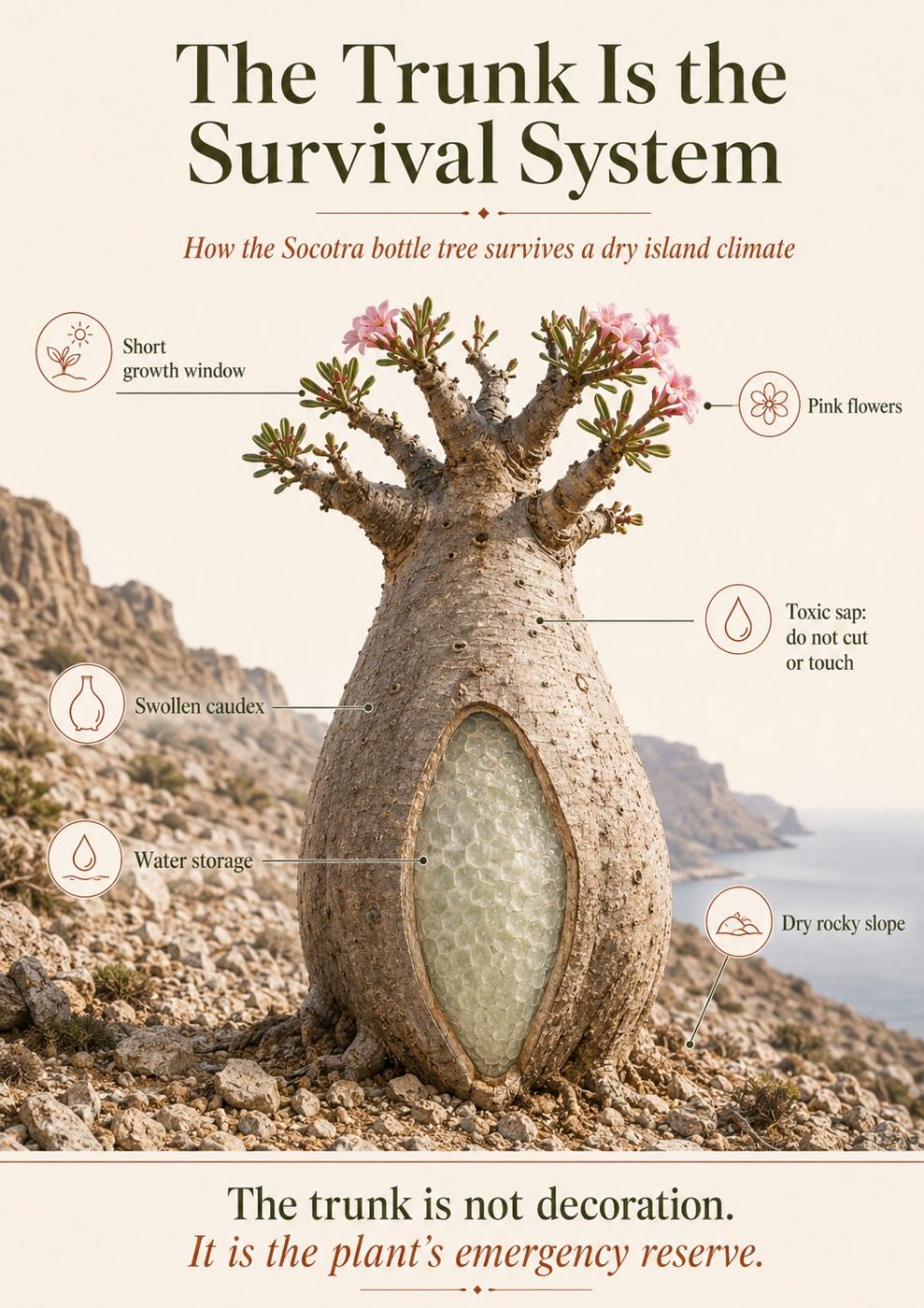
The trunk is not decoration. It is the plant’s emergency reserve.
Socotra’s bottle tree lives in a world where water is precious and unreliable. Its swollen caudex allows it to store moisture during favourable periods and survive when conditions become dry again. The plant does not need to look lush all the time. It can hold resources in its body and wait.
This is one reason the plant looks so unlike a typical tree. A normal tree often seems to express itself through height, shade and branches. The Socotra bottle tree expresses itself through volume. Its swollen trunk is the visual sign of stored survival.
The adaptation is especially useful on rocky slopes and exposed ground. Thin soil cannot hold much moisture. Stone heats quickly. Wind dries surfaces. Rain may run off instead of soaking deeply. In that setting, a water-storing trunk is not a luxury. It is a way to keep living when the landscape looks almost empty.
The swollen body may also help buffer the plant through temperature stress. In simple terms, a thick water-rich trunk changes how the plant handles heat compared with a thin-stemmed shrub. The bottle tree is built like a reservoir, but also like a buffer against extremes.
That does not mean the plant is invincible. Stored water can be depleted. Young plants can still be vulnerable. Habitat can still be disturbed. But the bottle tree’s body tells you something important about Socotra: many plants here are not trying to look conventionally lush. They are trying to survive long dry gaps between moments of opportunity.
This is why the bottle tree feels so appropriate to Socotra. It looks strange because the island asks strange things of its plants.
Pink Flowers on Bare Wood
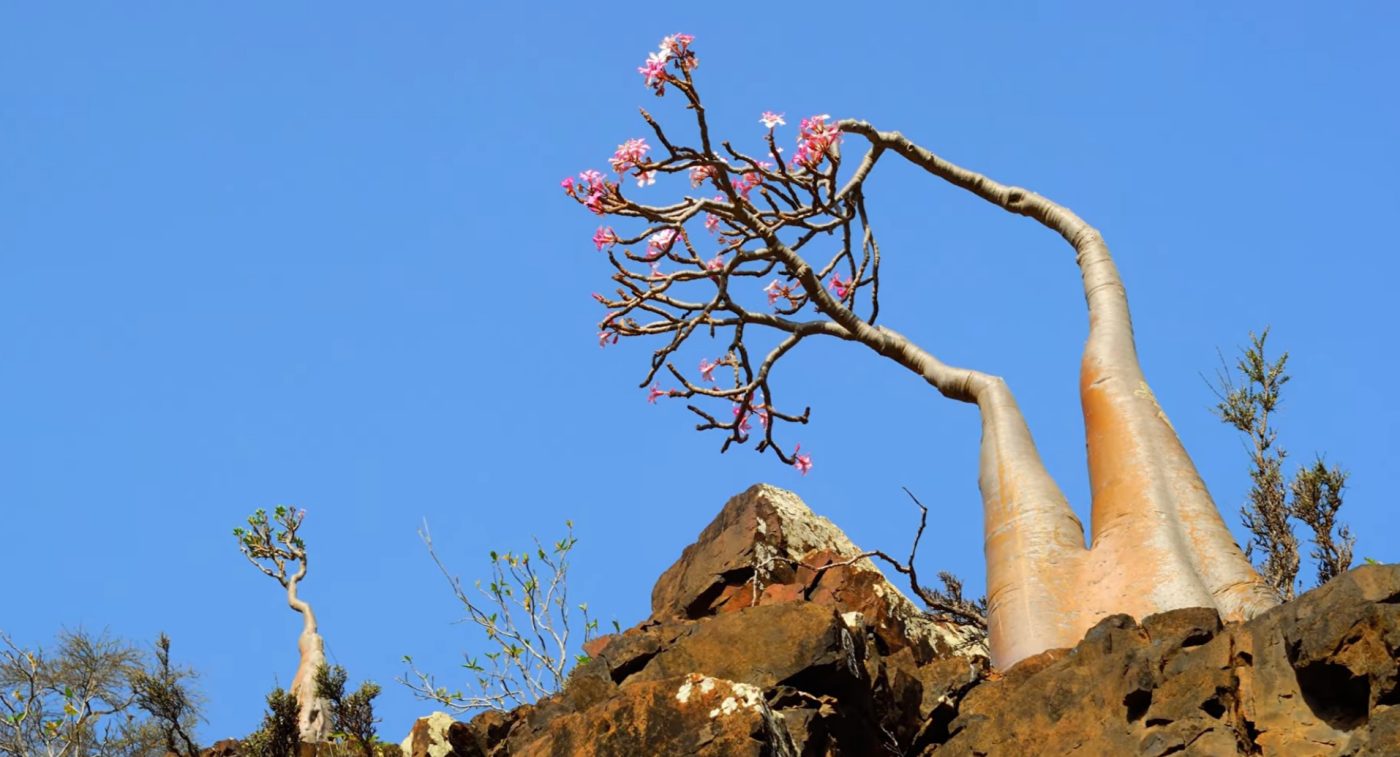
The Socotra bottle tree becomes especially striking when it flowers. Pink blossoms appear above a swollen pale trunk, often in a landscape of stone, dry slopes and muted earth colours. The contrast is sharp. It does not look like a garden shrub in a soft green setting. It looks like colour breaking out of a desert sculpture.
One reason the effect is so strong is that the plant may flower when it has few leaves or looks nearly bare. Instead of flowers hidden inside a mass of foliage, the blossoms sit visibly on the ends of branches. The trunk remains exposed. The structure remains clear. The plant does not lose its sculptural quality when it blooms; it becomes more theatrical.
This is the part many travellers want to see. A flowering bottle tree is one of Socotra’s most photogenic plant sights, especially when the background is dry rock rather than dense vegetation. The pink is not subtle. Against the right slope, it looks almost impossible.
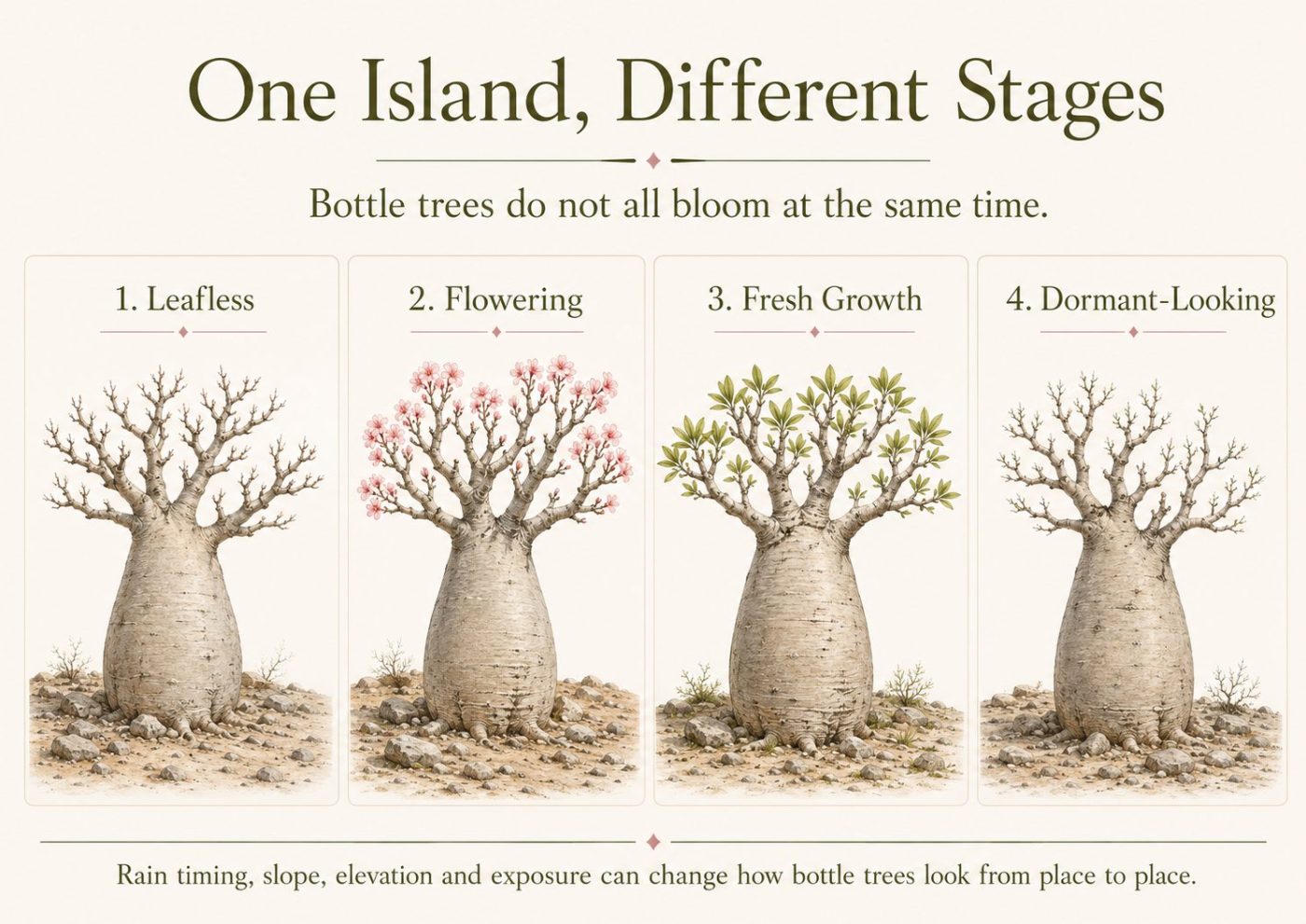
Still, the bloom should not be treated as guaranteed. Socotra is a place of microclimates. Rainfall, elevation, slope and timing all affect how plants look. A bottle tree in one area may be flowering, while another not far away may be leafless, green, dormant-looking or past bloom.
When Do Bottle Trees Bloom on Socotra?
Bottle tree flowering on Socotra is usually associated with late winter and spring. March and April are the safest months to mention as a common flowering window, although some travel sources describe February to March and others point to early March through late April.
The important word is “often,” not “always.” Blooming depends on local conditions. A slope that received moisture at the right time may look very different from a drier area nearby. Even on the same trip, travellers may see some bottle trees in flower and others with little visible activity.
This is why expectations need to be realistic. If you visit Socotra only for one perfect image of a bottle tree covered in pink flowers, you may misunderstand the island. The plant is interesting even outside peak bloom. Its trunk, growth form, habitat and relationship with the dry landscape are the main story. The flowers are the dramatic chapter, not the whole book.
For broader seasonal planning, see the guide to the best time to visit Socotra. The main travel season and the best flowering window may overlap, but exact plant conditions can still vary by year and location.
Why Bottle Trees Do Not All Look the Same
One bottle tree may look fat, bare and dormant. Another may carry leaves. Another may be in flower. Another may look weathered and almost dead until you notice new growth at the branch tips. On Socotra, this variation is normal.
The island has many small climate differences. Elevation changes quickly. Slopes face different directions. Some areas catch mist or rain more often than others. A wadi may hold moisture longer than an exposed rocky slope. A plateau may dry differently from a canyon edge.
That means bottle trees do not all follow one simple visual schedule. The same species can appear in different stages across the island. This is one of the reasons local guiding matters. A good guide understands that Socotra is not a set of fixed postcard stops. It is a living landscape, and plants respond to recent conditions.
This also makes the bottle tree more interesting. It is not just a flowering object waiting for a camera. It is a plant constantly adjusting to moisture, heat and exposure. Some years may be showier than others. Some routes may be better than others. The island decides more than the itinerary does.
Where to See Bottle Trees on Socotra
Bottle trees are associated with dry rocky slopes, highland areas, canyon routes and places where Socotra’s endemic plant life becomes especially visible. They are not usually visited as one single “bottle tree forest” in the way travellers may think about dragon blood trees around Firmihin. Instead, they appear as part of the wider landscape.
The best places to mention for travellers are Homhil, Wadi Kalisan, and highland routes around Diksam Plateau. These areas also help connect the plant to the larger geography of the island.
Homhil
Homhil is one of the strongest places to mention in a bottle tree article because it combines endemic plants, elevated views and a classic Socotra nature setting. Travellers often know Homhil for its natural pool, but the surrounding landscape is just as important.
This is the kind of place where the bottle tree makes sense visually. Dry slopes, exposed ground, strange plant forms and wide views all work together. The plant is not isolated from the experience; it is part of why Homhil feels so different from an ordinary island viewpoint.
Homhil is also useful because it can connect bottle trees with the wider endemic plant story of Socotra. A traveller may see bottle trees, dragon blood trees, frankincense trees and other unusual vegetation in the same broader area or route, depending on the itinerary and local conditions.
Wadi Kalisan
Wadi Kalisan is another useful location for this article because it gives the bottle tree a canyon and wadi context. Socotra is not only plateaus and beaches. Its wadis and rocky inland routes often show the island’s plant life in a more intimate way.
In a place like Wadi Kalisan, the bottle tree feels less like an isolated botanical specimen and more like part of the dry canyon landscape. Rock, slope, seasonal water, heat and sparse vegetation all matter. The swollen trunk becomes easier to understand when you see the kind of terrain it grows in.
This is also a good internal link because it broadens the article beyond the most obvious highland names. Many competitors simply say “on Socotra.” A better article tells readers where the plant fits into real routes.
Diksam Plateau and Highland Routes
Diksam Plateau is better known for dragon blood trees, canyon views and highland scenery, but it still belongs in the wider plant conversation. The route helps travellers understand that Socotra’s interior is not one single habitat. It is a mix of plateaus, valleys, slopes and exposed terrain where different endemic plants dominate in different places.
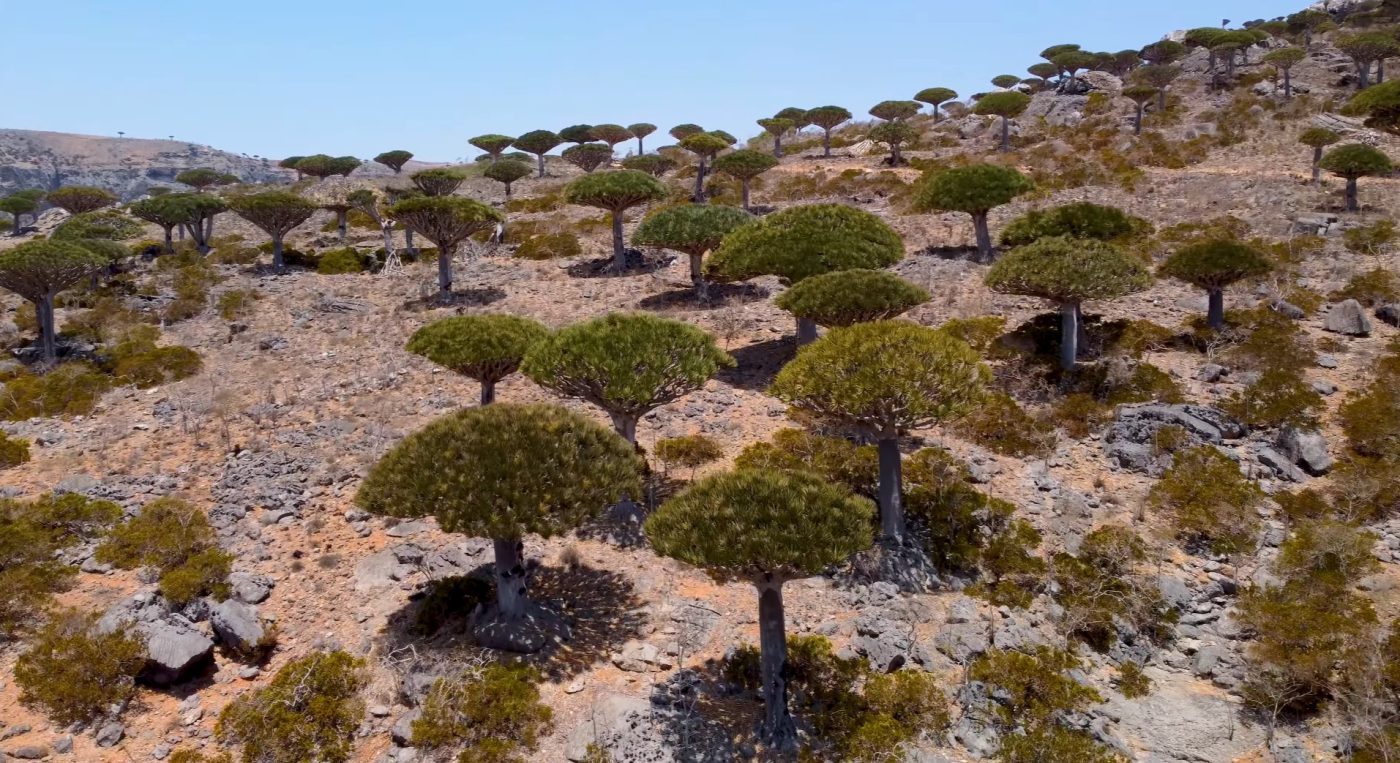
If your route includes Diksam, nearby inland landscapes may give context for how bottle trees differ from dragon blood trees. The dragon blood tree is all about the umbrella crown. The bottle tree is all about the swollen trunk. Seeing both on one trip makes the difference obvious.
Firmihin Forest and Nearby Highlands
Firmihin Forest should not be presented as the main bottle tree site. It is much more strongly associated with dragon blood trees. Still, it can be mentioned carefully as part of the wider highland plant landscape.
The value of including Firmihin is comparison. It helps the reader understand that Socotra’s strange trees are not all the same. Firmihin’s signature is the umbrella-shaped dragon blood tree. Other routes and slopes may show the swollen bottle-tree form. Together, they make Socotra’s plant life feel unusually varied.
Useful places for seeing bottle tree landscapes
Homhil
One of the best areas for endemic plants, elevated views and the classic dry highland setting where bottle trees feel at home.
Best for: endemic plants and viewpoint scenery
Wadi Kalisan
A canyon and wadi landscape where bottle trees can be understood as part of Socotra’s dry rocky inland routes.
Best for: canyon context and rocky slopes
Diksam Plateau
Better known for dragon blood trees, but useful for understanding Socotra’s broader highland plant world.
Best for: highland contrast and route context
Firmihin Area
Mainly a dragon blood tree landscape, but helpful for comparing Socotra’s different iconic plant forms.
Best for: comparing strange Socotra trees
Is the Socotra Bottle Tree Poisonous?
Yes, the bottle tree should be treated with caution. Like other Adenium plants, it can contain toxic or irritating sap. The sap is not something to touch, taste or test. This matters because the plant’s swollen trunk and strange shape can tempt visitors to treat it like an object rather than a living organism.
The responsible rule is simple: do not cut the plant, do not break branches, do not touch the latex, and do not collect plant material. A bottle tree is best admired where it grows.
This is especially important for families and photographers. Children may be curious about the plant’s shape. Photographers may want a dramatic close-up of damaged bark or sap. Neither is worth it. The plant does not need to be wounded for a better image.
The toxic sap also helps explain why the bottle tree’s conservation story is different from some other plants. Animals may avoid it more than they avoid softer, more palatable young growth. That does not make the plant invulnerable, but it does mean grazing pressure works differently here than with plants that livestock readily eat.