

The dragon’s blood tree is the image most people carry in their head when they first hear about Socotra. A thick umbrella-shaped crown. A dry stone plateau. A strange red resin that gave the tree its dramatic name. It looks almost invented, as if someone designed it for a fantasy landscape and then forgot to make it ordinary.
But the dragon’s blood tree is not strange for decoration. Its shape, resin, slow growth and limited range all belong to the same story: an isolated island, a hard climate, old trade routes, local knowledge and a species now under real pressure. On Socotra, this tree is more than a symbol. It is part of the island’s ecology, identity and travel experience.
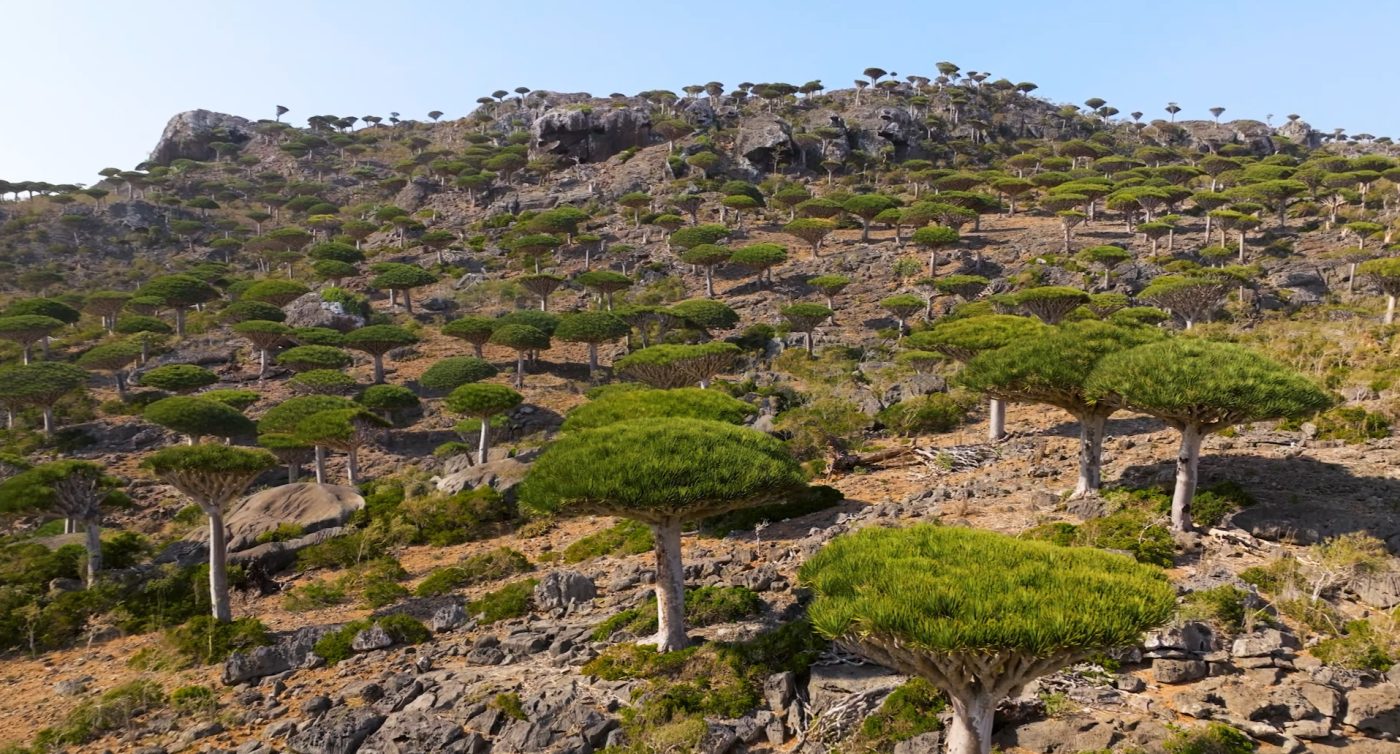
The most famous places to see dragon blood tree landscapes are the central highlands, especially Firmihin Forest and Diksam Plateau. These are not polished botanical gardens. They are rough, open, wind-cut places where the trees stand against limestone, canyon edges and wide empty sky.
Dragon’s blood tree at a glance
A fast summary of Socotra’s most famous tree before getting into the deeper ecology, travel context and conservation issues.
Dracaena cinnabari
Socotra Island, Yemen
Umbrella crown and red resin
Firmihin Forest and Diksam Plateau
Vulnerable
Poor regeneration, grazing, climate pressure
What Is the Dragon’s Blood Tree?
The dragon’s blood tree is an endemic tree of Socotra, known scientifically as Dracaena cinnabari. Endemic means it grows naturally in one specific region, and in this case that region is Socotra. Not mainland Yemen. Not the Arabian Peninsula in general. Socotra.
Its common name comes from the red resin inside the tree. When the bark or wood is damaged, the resin can appear deep red, which is why people have long associated it with “dragon’s blood.” The name sounds mythical, but the material itself was a real trade product, used historically as a dye, pigment, varnish and traditional medicine.
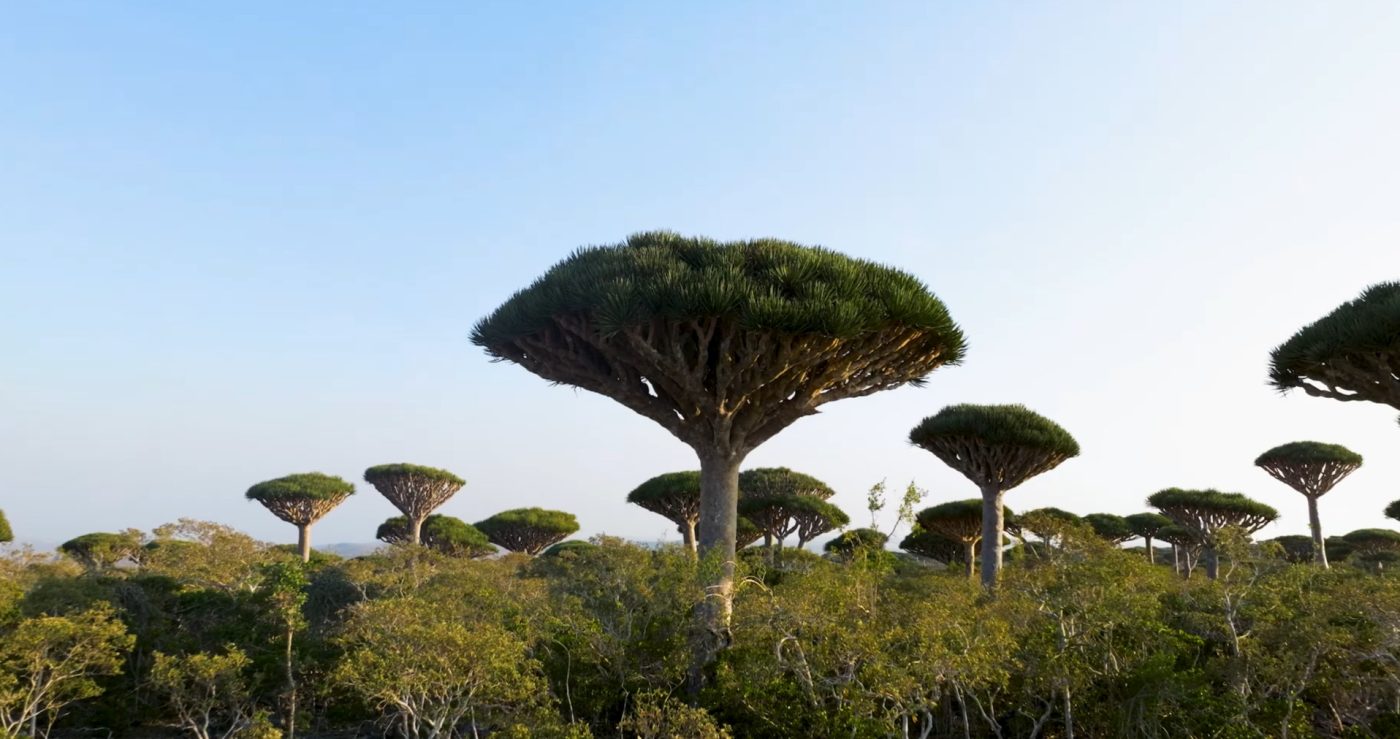
The tree’s most obvious feature is its crown. Mature trees form a dense, flattened canopy that spreads outward like an umbrella. From a distance, a group of dragon blood trees can look like a forest of giant green parasols scattered across pale stone. Up close, the structure feels tougher and stranger: thick branches, stiff leaves, dry ground, sharp light.
The dragon’s blood tree belongs to the wider group of arborescent Dracaena plants. That matters because it is not a typical broadleaf tree in the way many visitors imagine. It grows slowly, has a very distinctive branching habit, and does not behave like a familiar oak, pine or palm. Its age is also difficult to estimate with casual certainty, which is why claims that every large tree is “1,000 years old” should be treated carefully.
Socotra has several plants that look almost unreal at first sight. The bottle tree of Socotra and the cucumber tree of Socotra tell the same larger story: on this island, unusual forms often come from practical adaptation, not visual drama alone.
Why Does the Dragon’s Blood Tree Grow on Socotra?
Socotra is one of the world’s great island laboratories. Its long isolation, dry climate, monsoon influence and rugged terrain created conditions where many species evolved in unusual directions. The dragon’s blood tree is part of that pattern. It is not just a famous tree that happens to grow on Socotra. It is a Socotran species shaped by the island itself.
The tree is most closely associated with upland and plateau landscapes rather than soft tropical beach scenery. This is important for travellers. If you come to Socotra only expecting turquoise water and sand, the dragon blood tree will surprise you. Its world is more austere: limestone plateaus, dry slopes, rough tracks, canyon edges, wind and exposed ground.
The central highlands around Diksam Plateau are especially important because they show the tree in its strongest visual context. Here, the landscape is open enough that the shape of each tree matters. You see the crowns against the horizon. You see how far apart many of them stand. You see the space between the trees as much as the trees themselves.
Other areas, such as Homhil, show a different side of the same island ecology. Homhil is known for endemic plants, elevated views and a natural rock pool, and it gives travellers a broader sense of how Socotra’s highland and mountain environments differ from the coast.
This is why the dragon’s blood tree works best in an article not as a single oddity, but as an entry point into Socotra’s wider ecosystem. The island is not strange because of one species. It is strange because so many of its species, landscapes and rhythms do not fit the usual idea of an island trip.
Where to See Dragon’s Blood Trees on Socotra
The dragon’s blood tree is native to Socotra, but that does not mean travellers see it equally everywhere. The best-known landscapes are in the highlands, especially around Firmihin, Diksam and Homhil. These places are usually reached as part of an organized overland route, not as casual roadside stops.
Firmihin Forest
Firmihin Forest is the most important place to mention in any article about dragon blood trees on Socotra. It is the classic landscape: large numbers of trees spread across the central highlands, with the strange umbrella crowns appearing again and again across the dry terrain.
The word “forest” can be slightly misleading if someone imagines a shaded European woodland. Firmihin is more open, rough and exposed. The trees do not create a soft enclosed canopy overhead. Instead, they stand across the plateau, giving the landscape its alien-looking rhythm. This openness is part of the power of the place.
For travellers, Firmihin is usually not a long technical hike. The experience is more about walking slowly, looking at the tree forms, understanding the scale of the plateau and seeing how the species sits in the wider highland environment. The best visits are unhurried. A quick photo stop misses the point.
Diksam Plateau
Diksam Plateau is another essential location. It is one of the strongest inland landscapes on Socotra, combining dragon blood trees, limestone terrain, canyon views and rough highland roads. Many routes naturally pair Diksam with Firmihin because the two places belong to the same central highland experience.
Diksam gives the dragon’s blood tree a dramatic setting. The tree is not just standing in empty land; it is part of a plateau landscape cut by valleys and viewpoints. In some places, the ground drops away into canyon scenery, which makes the wide crowns feel even more sculptural.
This is also where travellers begin to understand that Socotra is not a soft trip. The roads can be rough. The wind can be strong. The light can be harsh. The landscape feels stripped down. For many visitors, that is exactly why it stays in the memory.
Homhil
Homhil offers a different way to experience Socotra’s endemic plant life. It is often described through its natural pool and elevated views, but the area is also important for understanding the island’s rugged vegetation and highland ecology.
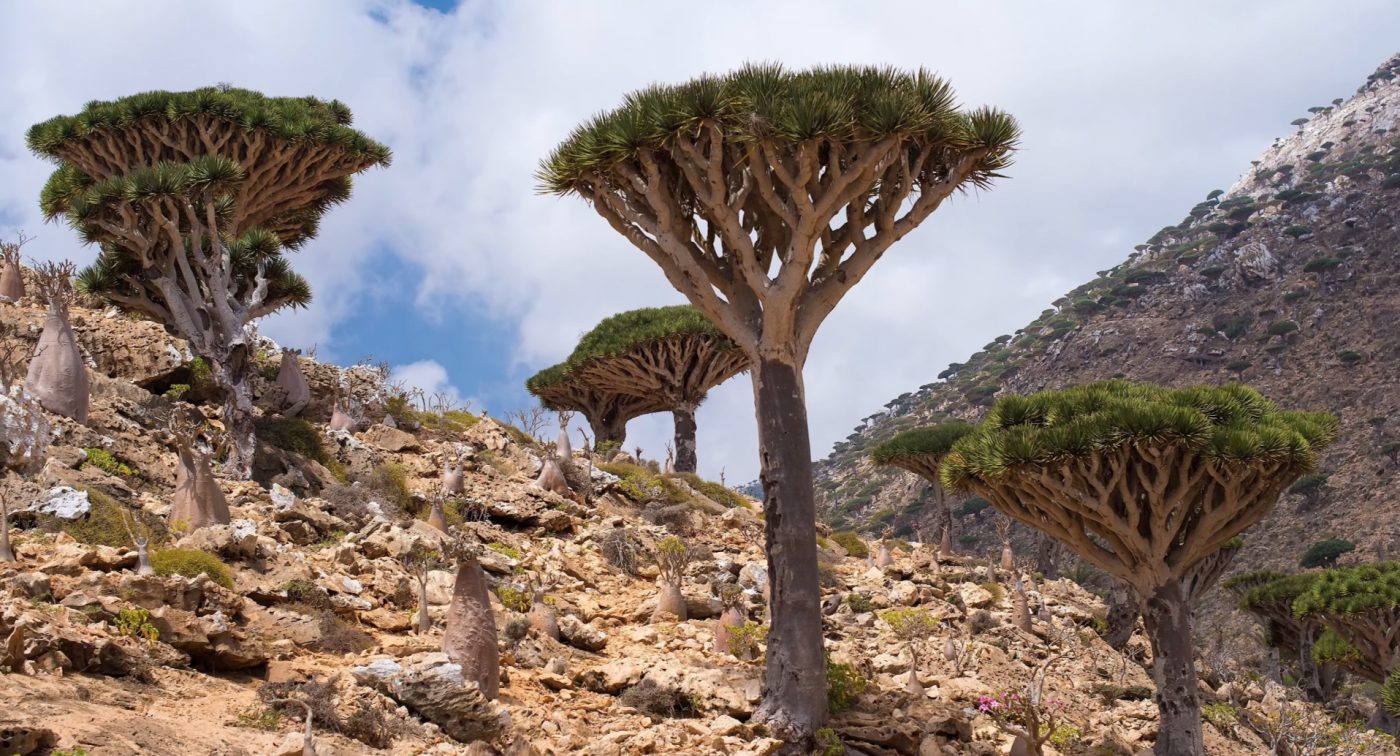
Homhil is not simply “another place with dragon blood trees.” It has its own mood. The walk, the views, the scattered endemic plants and the natural pool make it feel more like a mountain nature stop than a pure tree-viewing site. It works well in a route that also includes eastern or northeastern places such as Hoq Cave.
For an article, Homhil is useful because it stops the reader from thinking that dragon blood trees exist only in one famous forest. Firmihin may be the headline location, but the broader highland ecology of Socotra is more varied than a single stop.
Dirhur Canyon and Nearby Highland Routes
Dirhur Canyon is not usually described as the main dragon blood tree site, but it belongs naturally in the same highland travel conversation. It helps connect the tree landscapes with the deeper inland character of Socotra: canyon walls, dry valleys, rough tracks and the sense of moving through a remote plateau rather than a resort island.
If the article includes a route section, Dirhur works well as an internal link after Firmihin and Diksam. It adds geographic depth without pulling the focus away from the dragon’s blood tree.
Best places to see dragon blood trees on Socotra
Firmihin Forest
The strongest dragon blood tree landscape on the island, with large numbers of trees spread across the central highlands.
Best for: classic dragon blood tree scenery
Diksam Plateau
A high limestone plateau where dragon blood trees, canyon views and rough inland roads create one of Socotra’s defining landscapes.
Best for: plateau views and highland atmosphere
Homhil
A protected mountain area with scattered dragon blood trees, endemic plants and a natural rock pool overlooking the valleys.
Best for: endemic plants and viewpoint hiking
Dirhur Canyon
Often combined with Diksam, this canyon landscape adds depth to the central highlands route around the dragon blood tree zone.
Best for: canyon scenery near Diksam
Why Does the Dragon’s Blood Tree Look Like an Umbrella?
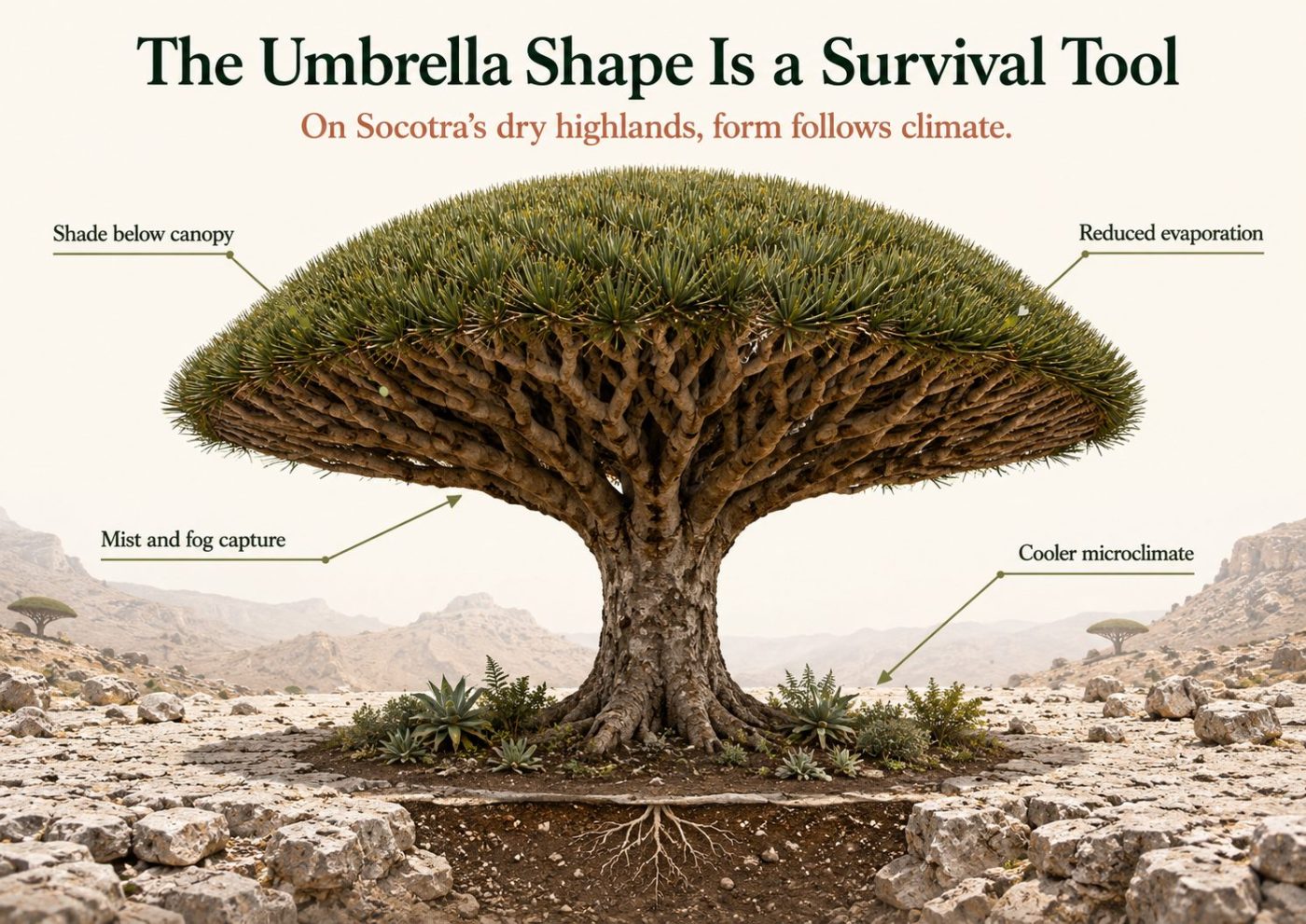
The dragon blood tree is not strange for the sake of being strange. Its umbrella crown is a survival shape.
Socotra’s highland environments can be dry, exposed and unforgiving. A dense crown helps the tree create shade below itself, reducing heat stress around the trunk and root zone. The canopy also helps the tree deal with scarce moisture. In a place where fog, mist and seasonal humidity matter, the shape of a tree is not just appearance. It is part of how the plant lives.
The crown spreads outward rather than rising into a tall narrow tower. This gives the tree its famous silhouette, but it also changes the microclimate beneath it. The ground below a mature tree can be cooler and more protected than the open land around it. That matters not only for the tree itself, but also for other small plants and seedlings trying to survive.
This is one of the most important points for a strong article: the dragon’s blood tree should not be described only as “weird” or “alien.” Those words attract clicks, but they flatten the biology. The better explanation is that the tree looks unusual because Socotra is unusual. The form is practical. The beauty comes afterward.
Why Is It Called Dragon’s Blood?
The name comes from the red resin. When the bark or wood is damaged, the tree can release a resin that darkens into a deep red material. To earlier traders and local users, that colour made the name almost inevitable. It looked like blood, and dragon’s blood sounded more powerful than “red tree resin.”
The phrase “dragon’s blood” has a long and complicated history. It has been used for red resins from different plants in different parts of the world, not only from Socotra’s Dracaena cinnabari. That is worth mentioning because it prevents a common confusion. Socotra’s dragon’s blood tree is one famous source of dragon’s blood resin, but the name has also travelled through trade, medicine and folklore in broader ways.
Historically, dragon’s blood resin was valued as a pigment, dye, varnish ingredient and traditional remedy. In a travel article, this history adds depth. In a responsible article, it also needs limits. The resin should not be presented as a proven modern cure, and travellers should not be encouraged to cut the tree to see it.
The red resin is powerful visually, but a fresh wound is still a wound. The worst way to photograph a dragon’s blood tree is to damage it for the sake of proving its name.
Traditional Uses of Dragon’s Blood Resin
Dragon’s blood resin was historically valuable because it combined colour, rarity and practical use. It could be used as a dye or pigment, as a resinous material in varnish, and in local or traditional medicine. That mix of uses made it more than a curiosity. It was a product with meaning, movement and trade value.
On Socotra, the resin belongs to local knowledge as well as outside fascination. For outsiders, it is easy to reduce it to a dramatic fact: “the tree bleeds red.” For people who lived with the tree, the resin had more practical associations. It was part of a wider relationship between plants, landscape and daily use.
Still, modern writing needs to be careful. “Traditional use” does not mean “medical proof.” A good article can say that dragon’s blood resin was historically used in folk medicine. It should not tell readers that the resin cures diseases, heals wounds or should be consumed. That would be both irresponsible and unnecessary.
| Use | Historical dye and pigment |
|---|---|
| Material use | Varnish, colouring and resin-based products |
| Traditional use | Used in folk medicine, but not presented here as a proven modern treatment |
| Travel note | Visitors should not cut bark or collect resin from living trees |
Is the Dragon’s Blood Tree Endangered?
Strictly speaking, the dragon’s blood tree is officially listed as Vulnerable, not Endangered. That distinction matters. “Endangered” is a specific conservation category, not just a dramatic word for any species under pressure.
But the correction should not make the situation sound safe. Vulnerable still means serious concern, especially for a species that grows naturally only on Socotra. A tree with such a limited range has very little room for error when the climate shifts, grazing pressure increases or young trees fail to survive.
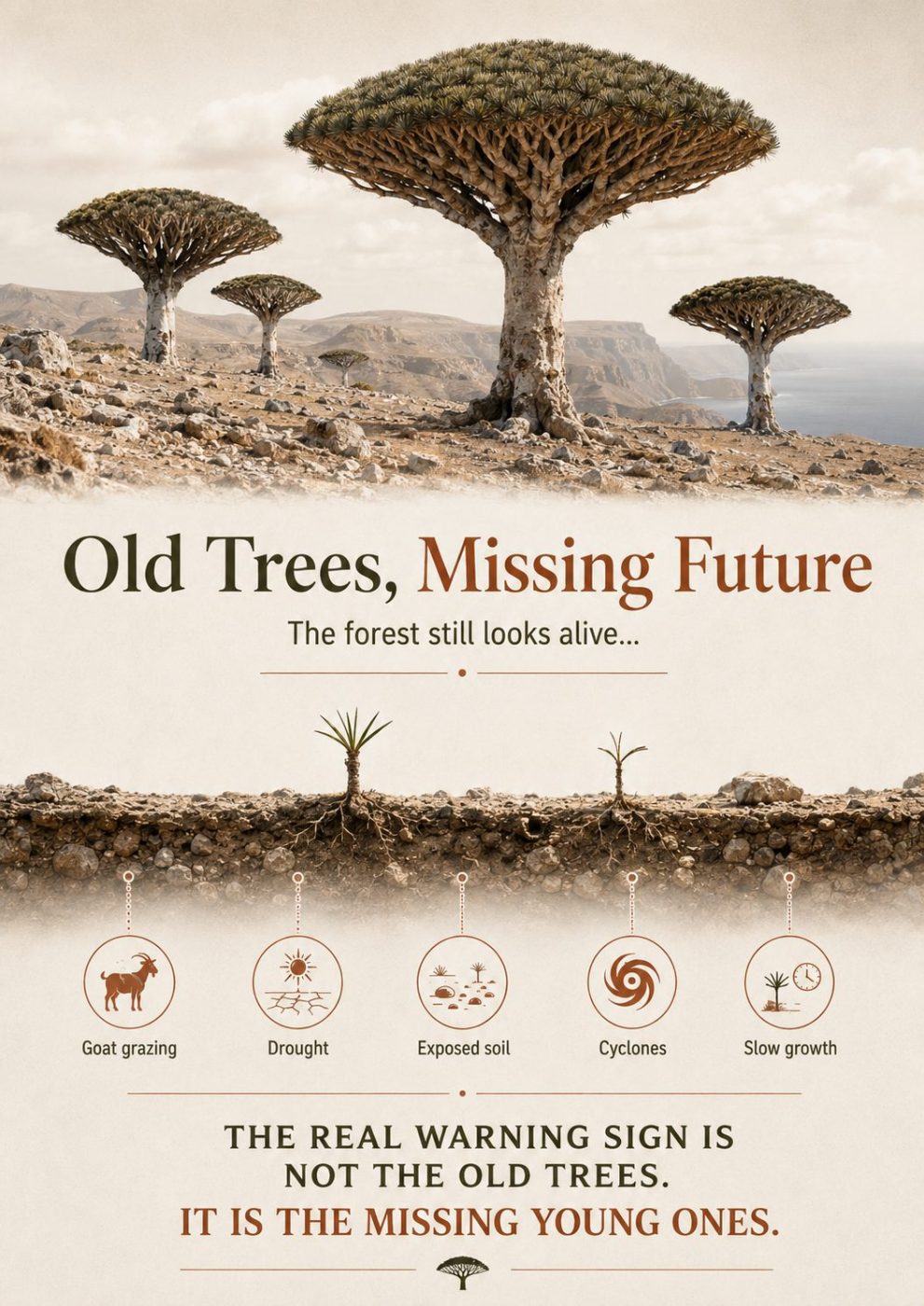
The real story is more subtle than a simple label. The dragon’s blood tree is not disappearing in the most obvious way. Large old trees still stand across famous landscapes, and photographs can make the population look timeless. The warning sign is lower to the ground: seedlings and young trees are often missing or struggling.
That is why the next section is central to understanding the species.
The Hidden Problem: Old Trees Without a New Generation
A dragon blood tree forest can still look healthy from a distance. The old crowns are there. The silhouettes are still dramatic. The photographs still work.
But conservation is often decided closer to the ground, where seedlings and young trees should be growing. If they are missing, the forest may already be ageing even while it still looks spectacular in photographs.
This is one of the strongest angles for understanding the dragon’s blood tree. The issue is not only whether old trees are dying. Old trees always die eventually. The issue is whether enough young trees are surviving to replace them. In many places, that replacement is weak.
Grazing is one reason. Young plants are much easier for goats and livestock to damage than mature trees. Climate pressure is another. Seedlings need the right conditions long enough to establish themselves. Add dry years, exposed ground, storms and human pressure, and the next generation becomes fragile.
That is why a forest can decline before it looks empty. The postcard image arrives late. The biological warning comes earlier.
Main Threats to Dragon’s Blood Trees
The dragon’s blood tree does not face one neat, simple threat. Its future is shaped by several pressures working together: grazing, weak regeneration, climate change, extreme weather and the difficulty of protecting a remote island landscape. That combination matters. A tree can survive one hard season. A species can struggle when every stage of its life cycle is under pressure.
Goat Grazing
Goats are often mentioned in discussions about the dragon’s blood tree, but the problem is sometimes misunderstood. The main issue is not that goats are knocking down large old trees. Mature dragon blood trees are tough, woody and difficult to destroy casually. The more serious problem is what happens to the young plants.
Seedlings and young trees are vulnerable. They are closer to the ground, easier to browse, easier to trample and less able to recover from damage. If goats repeatedly eat or damage young growth, the forest loses its replacement generation. The old trees remain visible, but the future forest is quietly removed.
That is why fenced nursery areas and protected regeneration zones matter. Planting a young dragon blood tree is only the beginning. Keeping it alive long enough to become independent is the real work.
Climate Change and Drier Conditions
The dragon’s blood tree is adapted to dry conditions, but adaptation has limits. A dry-climate species can still suffer if conditions become too dry, too hot or too irregular. Socotra’s highland trees rely on a delicate balance of elevation, mist, seasonal moisture and local microclimate.
If suitable habitat shrinks, the tree cannot simply move quickly to a better place. It grows slowly, its range is limited, and the island itself is finite. That makes climate pressure more serious than it might look at first. The tree is already living in a narrow ecological window.
The umbrella-shaped crown helps manage heat and moisture around the tree, but it does not make the species invincible. A survival shape is not a guarantee.
Cyclones and Extreme Weather
Socotra can be hit by severe weather, and cyclones are especially damaging because they affect both old trees and young regeneration. Strong winds can break branches or damage mature trees. Heavy rain and runoff can disturb slopes, tracks and soil. Young plants are even more exposed.
Extreme weather also makes conservation harder. A protected young tree may survive grazing, only to face drought, storm damage or water stress. In a remote island setting, recovery after major weather events is not simple or fast.
Weak Regeneration
Weak regeneration is the thread that connects many of the other threats. If a species still produces young plants and those young plants survive, the landscape can renew itself. If that cycle breaks, even a beautiful old forest becomes fragile.
For the dragon’s blood tree, the missing-young-tree problem is the part readers should remember. It is easy to care about a giant old tree. It is harder to notice the seedling that never gets a chance to become one.
Human Pressure and Limited Protection
Socotra’s remoteness protects it in some ways, but it also makes conservation complicated. Roads, tourism pressure, grazing practices, limited infrastructure and wider political instability all affect what can realistically be protected. Conservation is not just a scientific decision. It has to work for people living on the island.
That is why the best protection is usually practical and local: fenced areas, nurseries, careful guiding, respect for grazing realities, and long-term attention rather than one-time planting campaigns.
Why dragon blood trees are difficult to protect
Dragon’s Blood Trees and Socotra’s Wider Ecosystem
The dragon’s blood tree is Socotra’s most famous plant, but it should not be treated as the island’s only botanical story. Its fame works best as a doorway. Once a traveller understands this tree, the rest of Socotra’s plant life starts to make more sense.
The island has other strange endemic species, including the swollen-trunk bottle tree of Socotra and the unusual cucumber tree of Socotra. These plants look odd to visitors because they evolved under pressures that are not familiar from ordinary temperate or tropical landscapes.
That is why Socotra should never be described as just a beach destination with a few strange trees inland. Its coasts are spectacular, but its real identity comes from contrast: white sand, limestone plateaus, caves, lagoons, dry valleys, endemic plants and a sense of biological isolation that is hard to find elsewhere.
The dragon’s blood tree also plays an ecological role in its own surroundings. A mature tree can create shade, influence moisture below its canopy and shape a small microhabitat around itself. It is not just standing in the landscape. It helps structure the landscape.
How to Visit Dragon’s Blood Tree Landscapes Responsibly
Seeing dragon blood trees is one of the highlights of a Socotra trip, but the experience should not damage the thing people came to see. This is especially important because the tree’s most famous feature — red resin — appears when the bark or wood is damaged.
The rule is simple: do not cut, scrape or wound the tree. Do not ask a guide or local person to “show the blood” by damaging fresh bark. Do not collect resin from living trees. Do not step into nursery or protected regeneration areas. Do not treat seedlings as invisible just because they are not photogenic yet.
The worst souvenir from a dragon blood tree is a fresh wound in the bark.
Responsible travel here is not complicated, but it does require restraint. Stay with local guidance. Walk carefully on uneven ground. Keep distance from young plants. Avoid turning the tree into a prop for aggressive photos. Socotra’s landscapes are dramatic enough without forcing them to perform.
This also applies to buying resin or plant products. If something is offered as “real dragon’s blood,” travellers should think carefully about sustainability, source and legality. A rare tree should not become a souvenir supply chain for visitors who only know it from a photograph.
Best Time to See Dragon’s Blood Trees on Socotra
The main Socotra travel season is usually from October to April. This is the period most travellers focus on because conditions are generally more manageable for overland routes, camping, highland visits and coastal stops. For dragon blood tree areas, it is also the most practical season to plan around.
The highlands can feel different from the coast. Wind, cloud, mist, sun exposure and road conditions all matter. A visit to Diksam or Firmihin is not only about the calendar month; it is also about the conditions on the day. Strong light can make the landscape feel harsh. Softer morning or late afternoon light often gives the trees more shape and depth.
For a broader seasonal overview, see the full guide to the best time to visit Socotra.
When dragon blood tree landscapes are easiest to visit
How Dragon’s Blood Trees Fit Into a Socotra Route
Dragon blood trees are rarely visited as a single isolated stop. They usually fit into a wider Socotra route that moves between the central highlands, eastern landscapes and coastal highlights. This is one of the reasons the island feels so varied. A traveller can move from dry plateau trees to dunes, lagoons, caves and coral coastlines within the same trip.
The most natural inland combination is Diksam Plateau, Firmihin Forest and Dirhur Canyon. Together, they show the central highlands at their strongest: dragon blood trees, canyon scenery, rough roads and the dry open character that separates Socotra from ordinary island travel.
Another useful pairing is Homhil with eastern or northeastern sites such as Hoq Cave. This gives the route a different rhythm: walking, viewpoints, endemic plants, cave landscapes and coastal movement.
After the highlands, many itineraries shift toward the coast. Places such as Arher Dunes, Dihamri, Detwah Lagoon and Qalansiyah make the contrast obvious. The island is not one landscape repeated. It is a sequence of different worlds.
How dragon blood tree sites fit into a Socotra route
Diksam Plateau
The route usually climbs into the central highlands, where limestone plateaus, canyon views and scattered dragon blood trees define the inland landscape.
Firmihin Forest
The strongest dragon blood tree landscape, often visited with Diksam and nearby canyon viewpoints as part of the same highland day.
Homhil
A different highland setting with endemic plants, scattered dragon blood trees and a natural pool overlooking the valleys below.
Coastal contrast
Many itineraries then move toward places like Arher, Dihamri, Detwah Lagoon or Qalansiyah, showing how different Socotra’s coast feels from the highlands.
Travel Safety and Planning Context
Socotra is part of Yemen, and travel planning should be approached seriously. Even when tours operate and the island feels separate from mainland headlines, conditions can change. Flights, permits, insurance, evacuation options and official travel advice all matter.
For that reason, a dragon blood tree article should not sell Socotra as a casual island escape. It is remote travel. It is usually organized through specialist operators. Facilities can be basic. Medical access is limited. Routes depend on weather, road conditions and local logistics.
Before planning any trip, read a current guide on
whether it is safe to travel to Socotra, check official travel advice in your own country, and make sure your insurance would actually apply. This is not the place to discover policy exclusions after something goes wrong.
Dragon’s Blood Tree Myths and Facts
| Claim | Better answer |
|---|---|
| It grows all over Yemen | No. Dracaena cinnabari is native to Socotra, which belongs to Yemen. |
| It is officially Endangered | Officially, it is listed as Vulnerable, though the conservation concern is serious. |
| The red resin is blood | No. It is resin released when the tree is damaged. |
| The resin is a proven modern cure | It has traditional uses, but it should not be presented as a medical treatment. |
| Tourists should scratch the bark to see the red sap | No. Damaging the bark for photos or souvenirs is irresponsible. |
| All big dragon blood trees are 1,000 years old | Many large trees are old and slow-growing, but exact age claims need careful sourcing. |
Practical Travel Facts
Useful facts before visiting dragon blood tree areas
| Main areas | Firmihin Forest, Diksam Plateau and Homhil are the most useful places to mention for travellers. |
|---|---|
| Road conditions | Highland access usually involves rough tracks and four-wheel-drive travel. |
| Walking level | Most visits involve short walks, uneven stone and exposed terrain rather than long technical hikes. |
| Best light | Morning and late afternoon usually give the strongest atmosphere for photography. |
| Responsible rule | Do not cut bark, scrape resin or disturb young plants and nursery areas. |
| Route pairing | Diksam and Firmihin are often combined with Dirhur Canyon, while Homhil may connect naturally with Hoq Cave or the eastern route. |
FAQ
Where does the dragon’s blood tree grow?
The dragon’s blood tree grows naturally on Socotra Island, Yemen. It is one of the island’s most famous endemic plants and is strongly associated with the central highlands.
Where is the best place to see dragon blood trees on Socotra?
The best-known places are Firmihin Forest and Diksam Plateau. Homhil is also useful for travellers interested in endemic plants and highland scenery.
Why is it called the dragon’s blood tree?
The name comes from the tree’s red resin. When the bark or wood is damaged, the resin can appear dark red, which led to the dramatic name “dragon’s blood.”
Is the dragon’s blood tree endangered?
Officially, Dracaena cinnabari is listed as Vulnerable, not Endangered. The species still faces serious pressure from weak regeneration, grazing, climate change and extreme weather.
Can tourists touch or collect dragon’s blood resin?
No. Visitors should not cut, scrape or damage living trees to see or collect resin. Seeing the red resin is not worth harming the tree.
Why does the dragon’s blood tree look like an umbrella?
The umbrella-shaped crown helps the tree survive harsh highland conditions by creating shade, reducing heat stress and helping manage scarce moisture.
How old are dragon’s blood trees?
Dragon blood trees are slow-growing, and many large specimens are old. However, exact age claims should be treated carefully unless they come from a reliable scientific source.
When is the best time to visit dragon blood tree areas?
The main Socotra travel season is usually October to April, when conditions are generally more manageable for overland routes, highland visits and camping.
Can you see dragon blood trees on a normal Socotra itinerary?
Yes. Most nature-focused Socotra itineraries include the central highlands, especially Diksam Plateau and Firmihin Forest, because dragon blood trees are one of the island’s defining sights.
What other endemic plants should travellers know about?
Two useful examples are the bottle tree of Socotra and the cucumber tree of Socotra. Together with the dragon’s blood tree, they show why Socotra’s plant life is so unusual.
Final Thoughts
The dragon’s blood tree is easy to admire from a distance. Its shape is unforgettable, its resin has a name that feels older than science, and its highland landscapes look unlike almost anywhere else. But the tree becomes more interesting when the simple wonder fades a little.
Then the harder story appears. A species that grows naturally only on one island. Old trees still standing while young trees struggle. A landscape shaped by drought, mist, grazing, storms and human use. A tourist icon that should not be treated like a prop.
The dragon’s blood tree is not just Socotra’s most famous plant. It is a test of how carefully people can look at a place that seems unreal at first glance. The tree is real. So are the pressures around it.