

After the hot coastal plains of western Socotra, the road to Diksam Plateau feels like a hard reset. The climb begins gradually, then the land starts lifting in earnest. Cliffs appear along the horizon, the road bends higher into the interior, and the air changes fast enough that you notice it without trying. Cooler, thinner, cleaner. Different.
Diksam Plateau sits in the heart of Socotra and looks nothing like the island’s famous beaches, lagoons, or low coastal stretches. Up here the landscape turns stony and elevated. Limestone shelves spread across the highlands, canyons cut deep into the terrain, and the vegetation shifts into something much stranger. This is dragon blood tree country.
These umbrella-shaped trees are the image most people remember from Socotra. Not beaches. Not fishing villages. Not white sand. These trees. And some of the island’s most recognizable dragon blood tree landscapes are found around Diksam and nearby Firmihin Forest.
That’s why the plateau matters so much in a Socotra route. It is not just another scenic stop thrown into an itinerary to fill space. It shows a completely different face of the island — higher, harsher, more surreal, honestly more memorable for a lot of people than the coast.
Diksam Plateau at a Glance
A high limestone plateau in central Socotra known for dragon blood trees, canyon viewpoints and some of the island’s most iconic upland scenery.
Central highlands of Socotra
Around 700–800 meters above sea level
Dragon blood tree landscapes
2–4 hours
Part of the central mountains route
The Landscape of Diksam Plateau
Diksam does not ease you into it. The plateau has a stern kind of beauty — wide limestone surfaces, broken ridgelines, sudden escarpments, and deep valleys that seem to open without warning. Down on the coast the scenery feels horizontal. Here it becomes vertical, fractured, exposed.
The plateau spreads across a large section of central Socotra, creating an elevated upland zone where wind moves across open ground and the views stretch far beyond the immediate road. In places the land feels almost empty. Then a group of dragon blood trees appears and suddenly the whole landscape starts looking alien again.
That contrast is what gives Diksam its weird power. Bare rock. Open sky. Then those impossible-looking tree crowns floating above the plateau on narrow trunks.
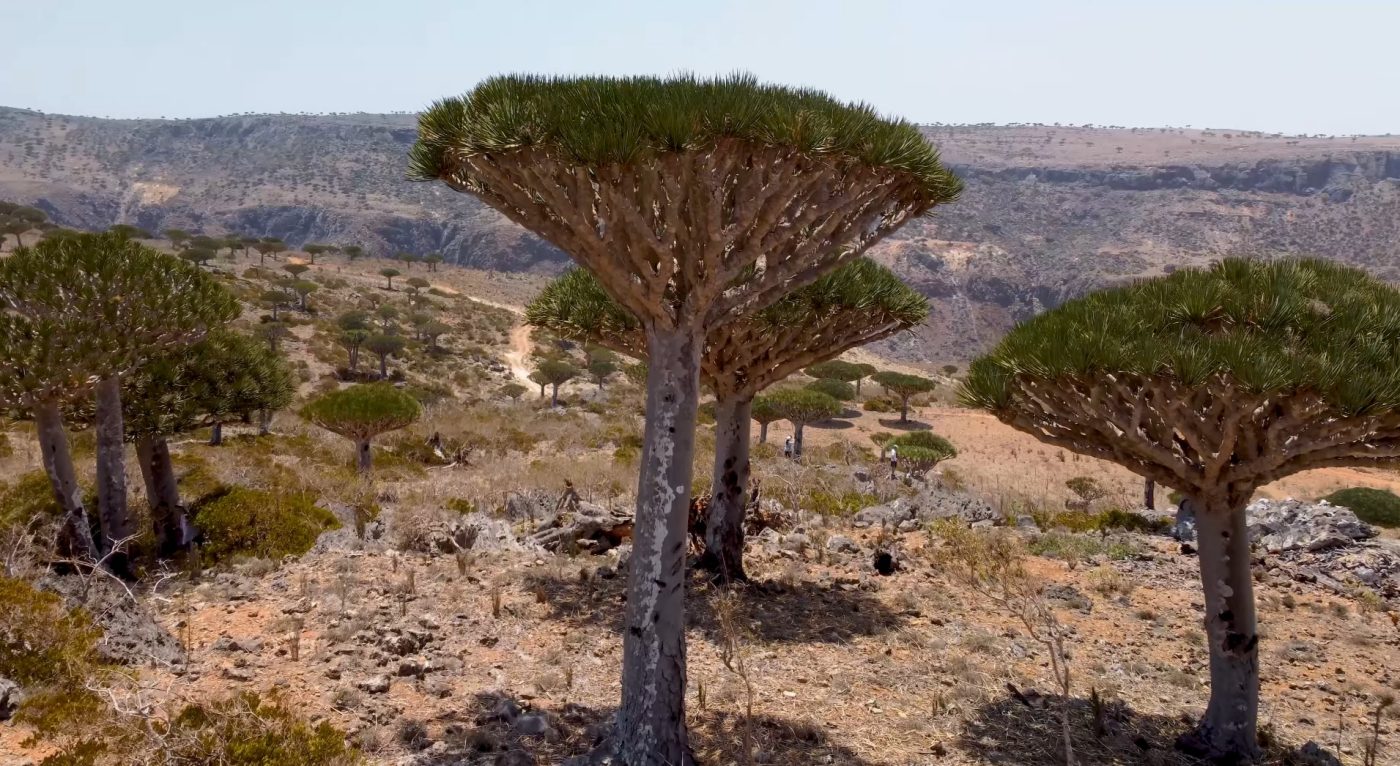
From a distance the dragon blood trees barely look real. Their canopies spread outward in dense rounded umbrellas, each one shaped with this strange geometric precision that feels designed rather than grown. A whole grove seen from the road can look like a field of giant green mushrooms planted across the limestone.
And then there are the canyon views.
The plateau edges break away dramatically toward nearby valleys, most famously around Dirhur Canyon. The limestone drops in steep walls toward lower terrain, exposing the structure of the highlands in a way the coast never does. You stand near the edge and suddenly the island opens below you in layers — ledges, ravines, broken rock, distant ridges fading into haze.
It’s the kind of place where people go quiet for a minute. Not because someone told them to. Just because the scale of it lands properly.
Dragon Blood Trees and the Ecology of the Plateau
The dragon blood tree is not just the visual symbol of Socotra. It is one of the clearest signs that the island’s ecology works by its own rules. These trees are adapted to the higher elevations, where cooler temperatures, mist, fog moisture and seasonal weather patterns give them a chance to survive in an environment that still looks, at first glance, brutally dry.
Around Diksam Plateau the trees grow across rocky ground in scattered stands. Some rise alone from the limestone, shaped by wind and exposure. Others gather in small groves that make the highland landscape feel denser, more structured. The nearby Firmihin Forest holds one of the best-known concentrations of dragon blood trees on the island and is often paired with Diksam in the same route.
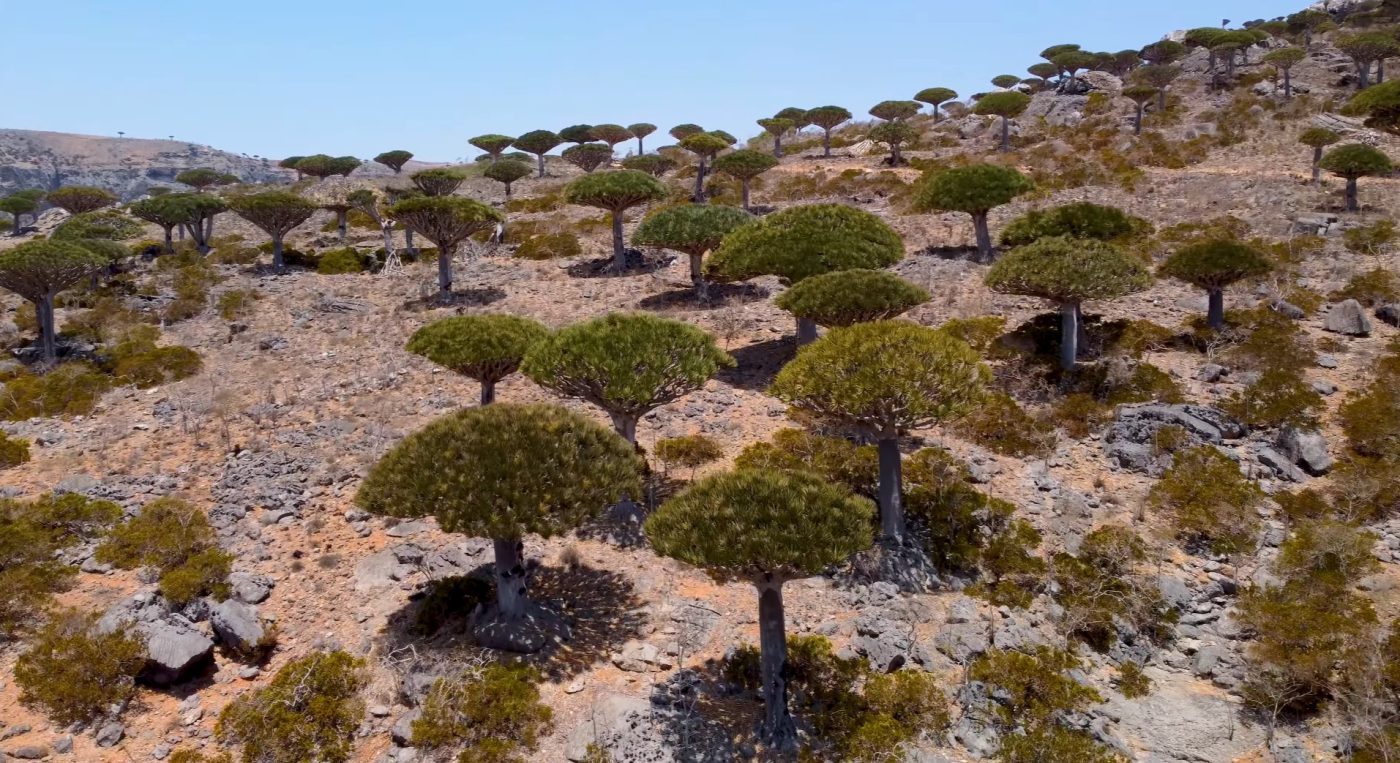
The shape of the tree is not random. That famous umbrella crown helps the species deal with tough conditions. The canopy creates shade below, reduces moisture loss, and helps collect water from fog and mist drifting across the plateau. In a place where rainfall is inconsistent, that matters a lot.
Honestly, the tree looks bizarre enough that people sometimes talk about it like a fantasy object first and a plant second. But its form is practical. Harsh climate, thin soils, exposed rock, moisture pulled from the air when direct rain is not enough. That’s not decorative weirdness. That’s survival.
This is also why the Diksam area feels so botanically important. The plateau is not only scenic. It is one of the island’s defining ecological zones, where endemic plant life and highland habitat come together in a way that explains why Socotra has such a strong reputation for biodiversity.
Why Diksam Feels So Different from Coastal Socotra
A lot of Socotra coverage leans hard on the coast — lagoons, beaches, white sand, fishing villages, boat trips, cliffs above the sea. Fair enough. The coast is gorgeous.
But Diksam changes the emotional register of the island.
The highlands feel less tropical, less soft, less obvious. More severe. More ancient, maybe. The land is drier to the eye, but more textured. You stop noticing water and start noticing form: limestone shelves, broken escarpments, wind-shaped vegetation, deep gorges, isolated tree silhouettes against the sky.
Even the light feels different up here. Sharper in some moments, flatter in others. Midday can make the plateau look almost bleached. Later on the trees throw longer shadows and the ground starts gaining texture again. Dust, rock, pale grass, dark green canopies. It all shifts.
That’s why Diksam sticks in memory. Not because it shouts. It doesn’t. It has this stark, almost withdrawn character, and that works on people slowly.
How Diksam Plateau Fits Into a Socotra Travel Route
Diksam Plateau is usually visited as part of the central highlands or mountain route across Socotra. After time on the west coast — places like Qalansiyah or Detwah Lagoon — many itineraries turn inland and begin climbing toward the island’s elevated interior.
That transition matters. It keeps the route from feeling repetitive.
Instead of one more beach stop or one more coastal viewpoint, the journey shifts into limestone uplands, canyon edges and endemic tree landscapes. The road itself becomes part of the experience. As elevation increases, the scenery broadens, the heat often eases, and the island starts looking bigger and wilder than it did from sea level.
Most travelers stop around the plateau for views, photography, short walks, and time among the dragon blood trees before continuing toward Firmihin Forest or other interior highlights. Some routes move on quickly. Others linger. I think lingering is better here, because Diksam is not a place that works best as a fast roadside glance.
It needs a little time. Wind in the open highlands, canyon views, the odd silence of those tree groves. That’s the real thing.
Typical Central Highlands Route
Drive Toward the Highlands
Travelers leave the coast and head inland, climbing from lower plains toward the elevated limestone landscapes of central Socotra.
Explore Diksam Plateau
The route reaches Diksam Plateau, where visitors stop for panoramic views, canyon scenery and some of the island’s most recognizable dragon blood tree landscapes.
Visit Firmihin Forest
From Diksam, many itineraries continue toward Firmihin Forest, one of the best-known areas for dense dragon blood tree stands in Socotra’s highlands.
Travel Conditions on Diksam Plateau
Getting up to Diksam Plateau means leaving the comfortable parts of Socotra behind for a while. The road climbs into the island’s central mountains and quickly turns into a narrow track carved along rocky slopes. Sometimes the vehicle edges past steep drops, sometimes it crawls over rough stone where the tires feel every bump.
The climb itself is half the experience. As the road winds upward the air shifts — a little cooler, a little sharper. The coastline disappears somewhere behind the hills and the horizon opens across the interior of the island. Look out the window and you start seeing deep valleys stretching away below the plateau edge, wide and dry and strangely quiet.
Infrastructure up here is… sparse. A few small highland settlements appear along the route, clusters of simple houses scattered across the plateau. But most of the area feels empty. Just rock, wind, and those strange trees that look like giant umbrellas growing straight out of the ground.
What to Expect When Visiting Diksam Plateau
That rough simplicity is normal for Socotra’s mountains. Development never spread deeply into the highlands, and the plateau still holds the fragile ecological balance that allows the famous dragon blood tree forests to survive here.
Best Time to Visit Diksam Plateau
Most travelers explore Diksam Plateau between October and April. Temperatures across Socotra settle into a more comfortable range during these months, and driving conditions through the mountains tend to be easier. Up here in the highlands the air usually feels noticeably cooler than along the coast.
Morning visits sometimes bring a strange little atmosphere to the plateau. Light fog can drift slowly across the landscape during the early hours. It slips between the scattered dragon blood trees, hangs low over the ground for a while… then gradually burns away once the sun climbs higher.
From June through September strong seasonal winds sweep across the island as part of the monsoon cycle. Those winds reach the mountains too. Roads across exposed sections of the plateau can become dusty, gusty, and a bit unpredictable to drive.
People still travel here outside the calmer months, sure. But most organized routes through Socotra prefer the quieter part of the year when visibility across the mountains stays clearer and the roads feel less chaotic.
How Long to Spend on Diksam Plateau
Most visitors spend somewhere between two and three hours on Diksam Plateau while traveling through Socotra’s central highlands. The plateau itself isn’t a single viewpoint — it’s more like a landscape you move through, stopping occasionally where the views open up.
Many travelers begin at the plateau edge where the ground suddenly drops toward Dirhur Canyon. Standing there you realize how dramatic the island’s interior really is. The canyon cuts deep through the terrain, and the scale of the landscape becomes obvious in a way photos never quite capture.
After those viewpoints, the route often continues toward the dragon blood tree areas near Firmihin Forest. That region holds some of the densest clusters of these strange umbrella-shaped trees anywhere on Socotra.
Distances across the plateau are larger than they first appear on a map. Even short stops require a bit of driving between them, which means the entire highlands section of the journey quietly fills most of the day.
Practical Travel Facts
| Location | Central highlands of Socotra Island |
|---|---|
| Elevation | Approximately 700–800 meters above sea level |
| Main attraction | Dragon blood tree landscapes and canyon viewpoints |
| Typical visit length | 2–4 hours |
| Nearby destinations | Firmihin Forest, Dirhur Canyon |
| Travel style | Part of the central mountains route across Socotra |
Final
Diksam Plateau feels completely different from Socotra’s coastal scenery. No lagoons. No beaches. The island changes character up here, shaped more by elevation and wind than by the sea.
The dragon blood trees scattered across the rocky ground give the place an almost prehistoric look. Thick trunks, wide canopies, strange shadows on the soil beneath them. Stand among them for a moment and the landscape starts feeling oddly timeless.
Together with nearby areas like Firmihin Forest, Diksam forms the core of Socotra’s mountain region. Travelers crossing the island often remember this stop long after the trip ends — something about those high plateau views and those bizarre trees sticking out of the earth.